/106/
Book IV
Dialectic
→ lat [327] Into the assembly of the gods came Dialectic, a woman whose weapons are complex and knotty utterances. Without her, nothing follows, and likewise, nothing stands in opposition. She brought with her the elements of speech; and she had ready the school maxim which reminds us that speech consists in words which are ambiguous,1 and judges nothing as having a standard meaning unless it be combined with other words. Yet, though Aristotle himself pronounce his twice-five categories, and grow pale2 as he tortures himself in thought; though the sophisms of the Stoics beset and tease the senses, as they wear on their foreheads the horns they never lost3; though Chrysippus4 heap up and consume5 his own pile,6 and Carneades match his mental power through the use of hellebore,7 no honor so great as this has ever befallen any of these sons of men, nor is it chance that /107/ so great an honor has fallen to your lot: it is your right, Dialectic, to speak in the realms of the gods, and to act as teacher in the presence of Jove.
→ lat [328] So at the Delian’s summons this woman entered, rather pale but very keen-sighted. Her eyes constantly darted about; her intricate coiffure seemed beautifully curled and bound together, and descending by successive stages,8 it so encompassed the shape of her whole head that you could not have detected anything lacking, nor grasped anything excessive.9 She was wearing the dress and cloak of Athens, it is true, but what she carried in her hands was unexpected, and had been unknown in all the Greek schools. In her left hand she held a snake twined in immense coils; in her right hand a set of patterns10 carefully inscribed on wax tablets, which were adorned with the beauty of contrasting color, was held on the inside by a hidden hook; but since her left hand kept the crafty device of the snake hidden under her cloak, her right hand was offered to one and all. Then if anyone took one of those patterns, he was soon caught on the hook and dragged toward the poisonous coils of the hidden snake, which presently emerged and after first biting the man relentlessly with the venomous points of its sharp teeth then gripped him in its many coils and compelled him to the intended position. If no one wanted to take11 any of the patterns, Dialectic confronted them with some questions; or secretly stirred the snake to creep up on them until its tight embrace12 strangled those who were caught and compelled them to accept the will of their interrogator.
→ lat [329] Dialectic herself was compact in body, dark in appearance, /108/ with thick, bushy13 hair on her limbs,14 and she kept saying things that the majority could not understand. For she claimed that the universal affirmative was diametrically opposed to the particular negative,15 but that it was possible for them both to be reversed by connecting ambiguous terms to univocal terms;16 she claimed also, that she alone discerned what was true from what was false,17 as if she spoke with assurance of divine inspiration. → lat [330] She said she had been brought up on an Egyptian crag18 and then had migrated to Attica to the school of Parmenides, and there, while the slanderous report was spread abroad that she was devoted to deceitful trickery, she had taken to herself the greatness of Socrates and Plato.
→ lat [331] This was the woman, well-versed in every deceptive argument and glorying in her many victories, whom the Cyllenian’s twofold serpent, rising on his staff, tried to lick at, constantly darting its tongues,19 while the Tritonian’s [Athena’s] Gorgon hissed with the joy of recognition. Meanwhile Bromius [Bacchus], the wittiest of the gods, who was completely unacquainted with her, said: “Surely this woman comes from the sands of panting Libya,20 as her braided /109/ hair and her fondness for venom suggest. Otherwise we must believe that she is a Marsian sorceress21: she is so well recognized by snakes, and they show their fondness for her in their slimy way. Apart from this, we may deduce from that concealed hook that she is proven a most alluring charlatan,22 and an inhabitant of the distant parts of Marsia.” → lat [332] When he had said this and several of the gods had laughed as much as was seemly, Pallas, rather shocked, restrained them as they were starting to make jokes, reminding them that this was a woman of perfect sobriety, something which had been wholly denied to some of the gods; and even amongst her sisters, who were estimable women, she was the most sharp-witted, and could not be scorned when she uttered her assertions. But Pallas ordered Dialectic to hand over those items which she had brought to illustrate her sharpness and her deadly sure assertions, and told her to put on an appearance suitable for imparting her skill. → lat [333] Grammar was standing close by when the introduction was completed; but she was afraid to accept the coils and gaping mouth of the slippery serpent. Together with the enticing patterns and the rules fitted with the hook, they were entrusted to the great goddess who had tamed the locks of Medusa.23 Thus Dialectic stood revealed as a genuine Athenian, a daughter of Cecrops, by the beauty of her hair and especially because she was attended by a crowd in Greek dress, the chosen youth of Greece, who were filled with wonder at the woman’s wisdom and intelligence. But, for assessing virtue as well as practicing it, Jupiter considered the levity of the Greeks inferior to the vigor of Romulus [i.e., the Romans], so he ordered her to unfold her field of knowledge in Latin eloquence. → lat [334] Dialectic did not think she could express herself adequately in Latin;24 but presently /110/ her confidence increased, the movements of her eyes were confined to a slight quivering, and, formidable as she had been even before she uttered a word, she began to speak as follows:
→ lat [335] “Unless amid the glories of the Latin tongue the learning and labor of my beloved and famous Varro had come to my aid, I could have been found to be a Greek by the test of Latin speech, or else completely uncultivated or even quite barbarous. Indeed, after the golden flow of Plato and the brilliance of Aristotle it was Marcus Terentius’ labors which first enticed me into Latin speech and made it possible for me to express myself throughout the schools of Ausonia. → lat [336] I shall therefore strive to obey my instructions and, without abandoning the Greek order of discussion, I shall not hesitate to express my propositions in the tongue of Laurentum [i.e., Latin.] First, I want you to realize that the toga-clad Romans have not been able to coin a name for me, and that I am called Dialectic just as in Athens: and whatever the other Arts propound is entirely under my authority. → lat [337] Not25 even Grammar herself, whom you have just heard and approved, nor the lady renowned for the richness of her eloquence,26 nor the one who draws various diagrams on the ground with her rod,27 can unfold her subject without using my reasoning.
→ lat [338] Indeed there are six canons on which the other disciplines rely, and they are all under my power and authority. The first concerns terms; the second, complete utterances; the third, propositions; the fourth, syllogisms;28 the fifth, criticism; that is, of poets and their works; while the sixth concerns the style suitable for orators. → lat [339] Under the first heading, one inquires what genus is, what is species, difference, accident, property, definition, the whole, the part, the difference between division and partition, and what is meant /111/ by equivocal, univocal, and (to coin a word) plurivocal. You should put up with the strangeness of my language, since you have compelled a Greek to treat the subject in Latin. → lat [340] The first part of my discipline considers the proper senses of words, the transferred senses of words, and the number of ways the sense can be transferred; it considers also substance, quality, quantity, relation, place, time, attitude, state, activity, passivity, opposition, and how manv modes of opposition there are. → lat [341] In the second part, which I have called On Complete Utterance, one investigates what is a noun, a verb, and the result of combining these; which of these is the subject part of a sentence, and which is the predicate part; what is the extent of the subject and of the predicate; how far the noun and the verb are taken;29 and how far a complete sentence can be a proposition. → lat [342] Next comes the third part, on propositions. In this one studies, so far as is sufficient for the purpose of today’s brief exposition, the differences in propositions as regards quantity, quality; what is the universal, the particular, the indefinite; which are affirmative, which negative; what is their individual force, and how they are related to one another. → lat [343] Then follows the fourth part, on the syllogism. In this we inquire what is a premise, a conclusion, a syllogism, a related conclusion; a categorical syllogism, a conditional syllogism, and the difference between the two; how many figures of the categorical kind there are and what they are; whether they adhere to a fixed order and, if they do, what is the explanation of that order; how many moods they each have and whether these moods adhere to a fixed order and, if they do, what is the explanation of that order; and, finally, how many fundamental and necessary moods of the conditional syllogism there are; what is the order of those moods, and what is the difference between them. These are the matters which I think are sufficient for our present understanding and exposition.
Therefore, going back to the beginning, in order to survey the whole subject I shall first explain30 what is meant by genus.
/112/ → lat [344] Genus is the embracing of many forms31 by means of a single name, as, for example, animal: its forms are man, horse, lion, and so on. But some forms sometimes fall under genera in such a way that they themselves can comprise a genus with other forms subsumed under it. For example, the genus man, which is a form in relation to animal, is a genus to barbarian or Roman. Genus can extend right down to the point where on dividing it into its forms you reach the individual. For example, suppose you were to divide men into males and females; likewise, males into boys, youths and old men; the likewise, boys into infants and those who can speak. If you wished to divide boy into Ganymede or some other particular boy, that is not a genus, because you have arrived at the individual. We ought to use the genus which is closest to the matter in hand, so that if we are discussing man, we ought to take animal as the genus because it is closest to our subject. For if we take as our genus substance, that is true in logic but is too wide for our needs.
→ lat [345] Forms, we say, are the same as species. Forms are those things which being subordinated to a genus retain32 its definition and name: man, horse, lion, since they are forms of animal, can each be called an animal and a corporeal living being; both the name and the definition are recognized as being those of the genus.
→ lat [346] Difference is a distinction adequate for the matter under discussion.33 For example, if one is asked what is the difference between a man and a horse, it is enough to say that a man has two feet and a horse four. However, we ought to be aware that, because there are many differences in individual cases, we are able to distinguish any given thing in different ways, as often as we can discover in it more and more points of difference. For if we want to divide the genus animal, we can divide it into sexes, since some are masculine, some feminine; we can divide it into age groups, since some are /113/ infant, some young, some old; we can divide it by sizes, since some are small, some large, some of medium size; we can divide it by their various modes of motion, since some walk, some crawl, some swim, some fly; or by their different habitats, since some live in water, some on land, some in the air, others, it is said, in fire;34 or by the sound of their cries, since some talk, some growl, some bark, some howl. But let us be sure that these individual divisions are complete and that all the members are included within the individual divisions. For male animals can include those recently born, small, walking, terrestrial, two-footed, and speaking. Therefore, of the possible distinctions, you ought to use that which is appropriate to the matter under discussion. For if you are to speak about mankind in a complimentary manner, you will have to divide animals into the rational and the brute, so that it may be more readily understood how great a value nature has placed on mankind amongst all the animals – since to men alone she has given the power of reason to come to knowledge of herself.
→ lat [347] Accident is something found only in a given species35 but which does not always occur in that species. For example, rhetoric occurs only amongst men, but it can fail to occur amongst them, so that although someone may be a man he need not be an orator.
→ lat [348] Property36 is what is found only in a given species and always occurs in it, so that it marks off the given thing from the generality of things; for example, laughter in man. For no one can laugh unless he is a man, and there is no man who cannot laugh when he wants to, so far as is in his nature. Difference is distinguished from property in this, that difference distinguishes something only by reference to the subject under discussion, whereas property distinguishes from everything. For when we want to distinguish man from lion by difference, and say that the lion is wild but man is gentle, clearly we make a distinction relevant only to the subject in question. For in saying The lion is wild, but man is gentle, /114/ we have not distinguished man from other tame animals, nor the lion from other wild animals. But when we call man an animal capable of laughter, we have thereby distinguished him from the generality of all other living things.
→ lat [349] Definition is the clear and brief explanation of any involved concept. In definition three things must be avoided: signifying what is false, what is too wide, or what is too narrow. We signify something false as follows: Man is an immortal, irrational animal. For although man is truly an animal, it is false that he is immortal or irrational. We signify too much when we say: Man is a mortal animal. For although this is brief, it is too wide, since it is true of all animals. We signify something too narrow when we say: Man is a grammatical animal. For although there is no animal except man with a knowledge of grammar, yet not every man has a knowledge of grammar. The full definition is Man is a rational, mortal animal37 For by adding the word mortal we have distinguished him from the gods, and by adding rational we have distinguished him from the beasts.
→ lat [350] A whole is that which sometimes lends its name but never its definition to two or more parts within itself. This is found only in individuals. For example, when we refer to a given man and consider his various limbs as his parts, we understand that the man himself is the whole, since we have decided on a particular man, and that the definition and name of that whole man cannot descend to his parts. For we cannot say that an arm or a head by itself is a man, nor can the separate limbs take the definition that belongs to man himself. Yet we must notice that sometimes it is possible to say all instead of the whole, but with a difference of meaning. For a whole is recognized in single items, but all is applied to a plurality. For when we say man, meaning Cicero, because Cicero is one person the appropriate term is the whole; but when we mean ‘mankind,’ because that can include the unskilled and the skilled, men and women, the better term is all.
→ lat [351] Parts are those which are understood to be present in a whole and of which the whole consists.
/115/ → lat [352] Division ought to be carried to the point at which we reach the individual; this comes when we reduce genera through their differences to cover a smaller number of items, and then we subordinate species to these in such a way that the separate species themselves can each be genera with other species subordinate to them.38 For instance, if we want to make a first brief division of animal, we can proceed by differences, because some animals walk, some crawl, some swim, some fly. Again, we can make genera of these divisions, so that we say that walking animals are a genus and we subordinate species to it, because some are human, some beasts. Of these again there can be other species, through which, if need be, it will be possible to reach the individual. This ought not to be done in every statement, but only in minute argument. In a speech39 we can divide in this way when the obscurity of our subject requires it; if the subject is not obscure, the theory of division should be applied and incorporated but ought not to be very apparent.
→ lat [353] In partition, specific differences40 do not often occur, and without them partition can be limitless, if we wish to reach what cannot be further divided. For if we name a particular man as a whole and wish briefly to enumerate his parts, there are no differences of parts available, and we are forced to use the names of the particular parts, so that we say the head, the feet, and the rest. If we want to group these briefly, the fact that there are no specific differences means that we cannot group the particular items; the fact that they are so many means it will be impossible, or else a very long task.
/116/ → lat [354] Between division and partition there is the difference that in division we proceed by species, in partition by parts. Species are what are subordinate to a genus and can retain its definition and name. Parts are those which are included in a whole, and they can never take the definition of the whole but sometimes can take its name. For we can take one and the same thing as both a genus and a whole, but with a certain difference of force. For instance, if we wish to divide man into youth, old man, and child, we have a genus and its species; but if we want it to be partitioned into head, feet, and hands, we have a whole and its parts. This is because youth, old man, and child, which as we have said are species, can take41 the name and definition of man, so that an old man may be called a man and a rational, mortal animal; and so may a child, and also a youth. But the head and the feet, which as we have said are parts, cannot take the definition or name of man, because a head cannot be said to be an animal capable of laughter,42 nor can the feet or hands.
→ lat [355] The equivocal43 occurs when many things have one name, but not the same definition; for instance, lion. For lion is applied to an actual lion, a picture of a lion, and the zodiac sign Leo, so far as the word goes, but as far as the definition is concerned, the actual lion is defined in one way, the painted lion in another, and the zodiac sign in another again.
→ lat [356] The univocal occurs when there is one name and one definition for two or more items; as, for instance, clothing. For /117/ both a cloak and a tunic have the name of clothing and can take its definition. Therefore the univocal is recognized in the genera,44 which give their name and definition to their subordinate species.
→ lat [357] The plurivocal occurs when one thing is known by many names; as, for instance, a sword: for gladius, ensis, and mucro all signify the same thing.45
→ lat [358] Words are proper to things when they are the natural and appropriate terms for them, as lapis [stone], lignum [wood], and so on.46
→ lat [359] Words are transferred [i.e., are used metaphorically] when they are changed in some way, either from necessity or for imagery: from necessity, as when we say vites gemmare [the vines are forming gems; i.e., are budding] or when we say laetas segetes [the crops are in good heart; i.e., are abundant].47 Here, since the proper word is lacking, we have used one transferred from another context: we cannot say that vines do anything except form gems, or that crops are anything except in good heart. But for imagery we say fluctuare segetes [the crops are rippling]; we can say something else – that they are moving – but since that is not decorative, we use a word proper to another subject.
→ lat [360] Words have a transferred sense in three ways: through similarity, or contrariety, or difference;48 through similarity, as are those which are included in the tropes of grammar, like the one /118/ have already mentioned: ‘the crops are rippling.’ Of this kind also are those which signify the part by the whole or the whole by the part in such a way that there is some appropriately close relationship between the words. It has been found desirable to include these under the heading of similarity. Words are used through contrariety when they are understood in a sense contrary to what we say, as when we call the Fates the Parcae although they are not merciful,49 or when use the word lucus [grove] although it does not transmit light.50 Grammarians call this antiphrasis. Words are transferred through difference when they are taken from other words without any reason, as if we were to call a man who was neither hard of body nor stupid of mind lapis [stone]. It is not appropriate to use these words; for it is stupid to bring forward words which either have no meaning or are transferred too far from their proper meaning. It is, however, right to use words that are proper, or similar, or contrary.
→ lat [361] Before I speak about substance,51 there are some things that need to be explained: everything that we say52 is either a subject itself, or of a subject, or in a subject, or both of and in a subject.53 /119/ A subject54 is itself not attributed to anything else in such a way that it is dependent on it for its existence, but other things are attributed to it; as, for instance, Cicero (not the name, but what is signified by that name). Something is of a subject55 when it is said of the subject itself and gives to it its definition and name; as, for example, man: for Cicero is a man and is a rational, mortal animal. So both the name and the definition, which is of the subject, have been predicated of the same subject; and thus what is said of the subject is found in its genera and species. → lat [362] Something is in a subject when it gives neither its name56 nor its definition to the subject but is understood to be in the subject itself in such a way that it cannot exist without the subject;57 as, for instance, rhetoric: for a subject cannot take the name and definition of rhetoric. For Cicero is not rhetoric, nor is Cicero the science of speaking well; but rhetoric is understood to be in Cicero, although he himself cannot be called rhetoric. Something is both of a subject and in a subject when it is of a subject with regard to one thing and in a subject with regard to another; as, for example, discipline: for with regard to rhetoric, discipline is of the subject; with regard to Cicero, it is in the subject. A primary substance, therefore, is a subject; a secondary substance is what is said of a primary substance. For instance, Cicero is a primary substance, man and animal are secondary. Now all the following categories /120/ are understood to be in a subject; so let us look at them one by one.
→ lat [363] A quality is that in accordance with which we say what a thing is like; for instance, whiteness. It can be understood that a quality is in a subject,58 since whiteness necessarily ;s in something, without which it cannot exist; the thing itself in which the whiteness exists is a subject.
A quantity is that in accordance with which we say how much a thing is; for instance, a length of two feet. This also must necessarily be in a subject.
The relative is what is so called in relation to something; for instance, father, brother. These are undoubtedly in a subject. For necessarily these names relate to something else. There are also some relative terms whose correlates will be evident in the mind.59
Place is what we call such expressions as in Rome; Rome is a substance, this bears reference to Rome itself.60 Time is, for instance, yesterday, recently, at evening. The things by whose movements time is reckoned, are substances; for instance, the sun, by whose course we understand time, and those bodies which give us understanding of interval. Attitude61 is, for instance, is-lying, is-sitting. State is, for instance, having-shoes-on, having-armor-on; man is /121/ the substance, these bear a reference to him. Activity is, for example, cutting, burning. Passivity is, for example, being cut, being burned.
→ lat [364] A primary substance, then, is what is not inseparably in a subject and is not predicated of any subject. “Inseparably” has been added to the definition62 for this reason – that every primary substance, though it may be in some locality, nevertheless can be separated and move from that locality; for example, Cicero is understood to be in the senate house in such a manner that he can go from there to some other place. And a part of a primary substance, though in the whole substance, is not inseparable from it, for our arm can be separated from our body, either in fact or in thought.63 Rhetoric, on the other hand, is in the mind of Cicero in such a way that, even if by some chance it ceased to be there, we do not understand that it is going somewhere else; for when it has begun to be in Cicero’s mind we do not consider it has come from elsewhere.
→ lat [365] A secondary substance64 is, as has been said, what is predicated of primary substance, as man is predicated of Cicero, and animal is predicated of man and Cicero. Whatever is the genus of a primary substance is understood to be a secondary substance. Therefore it is common to all substances not be in a subject, but primary substance is not of a subject either. Substance cannot be extended or reduced; that is, it cannot admit of a more and a less. If no man is more a man than any other man, and no particular man will be more a man tomorrow than he was yesterday, so in different species a horse is not more a horse than a man is a man. But in discussing substances we must be careful to compare within the same class; that is, to compare a primary substance with a primary, a secondary with a secondary. For the primary substance more directly signifies /122/ the thing; secondary substance involves the possibility of confusion with other things. When I say Cicero, I signify a definite individual; when I say man, it is uncertain whom I mean, because we are all subject to this title. Thus it happens that primary substance is more truly substance than is secondary substance; for primary substance more directly identifies the thing. → lat [366] The concept of more or less a substance cannot apply, therefore, among substances within the same class. Again, substance has no opposite; for there is nothing opposite to man, or horse. If someone says that Clodius was the opposite of Cicero, he means not that the substances were opposed to each other but that the qualities in them were opposites, such as evil opposed to good, vice to virtue, injustice to justice. It is clearly a property of substance that one and the same substance can accept opposite qualities by variation within itself. Thus a stone can be now white, now black, and not cease to be the same stone; and Cicero, at first foolish, later wise, does not cease to be the same Cicero.
→ lat [367] A quality,65 as I have said, is that in accordance with which we are said to be of a certain kind. Of qualities, one sort is that in which a certain disposition and habit of mind is understood; as, for instance, in all the acquired disciplines – philosophy, grammar, rhetoric, and the rest – which so take root in the mind that it is difficult for them to be lost from it. Amongst this sort, some are perfect, some imperfect; if someone has studied grammar yet often makes mistakes, one cannot refer to the habit (of grammatical knowledge], but only to the disposition. Not every disposition is regarded as a habit, but every habit is regarded as being a disposition. → lat [368] A second sort is what we call the ‘affective’ qualities, like sweet or bitter, hot or cold; not that the corresponding substances are affected by anything from these qualities, but that they compel our senses to be affected. For heat compels the person who comes in contact with it to be affected, as sweetness compels the person who tastes it. Again, there are the qualities which have been implanted in us by some natural affection, in accordance with which each of us is said to be pale or ruddy, without any sudden cause making us /123/ pale or ruddy. These are more rightly called affections than qualities,66 if we are not said to be of a certain kind because of them. For it does not follow that he who grows pale is a pale person, that he who loves is a lover, that he who is drunk is a drunkard. The former instances are affections; the latter, qualities. → lat [369] There is a third kind of qualities which are understood not from what actually exists in an individual case but from what can exist; for instance, we say that wood is breakable, not because it is already broken, but because it can be broken. Again, we speak of a body as athletic67 in two senses: both as one that has been athletically trained and as one so formed by nature that it is well-suited to athletics even though it has not in fact been athletically trained. The former kind of body is rightly called athletic from its athletic skill, because the skill is ingrained in it; but there does not exist any name for the quality itself from which the abjective has been derived and named to apply to a body which is able to be athletically trained but is not so yet. Therefore we must recognize that some substances are said to be what they are from qualities for which there are no names. For though we speak of good as derived from goodness, we do not speak of best as derived from ‘bestness.’68 In the same way athletic, which we understand from the fact that a body can acquire athletic skill, does not have a definite name for the quality from which it is seen to be so called, yet we agree that it is so called from a quality. → lat [370] The fourth kind of quality covers those according to which we understand the shapes and configurations of things, such as square, round, /124/ beautiful, ugly,69 and the like. Quality accepts the idea of a more and a less, but not in every instance. For nothing square is more square than any other square thing; but something can be said to be more white than another white thing. And it is a question often discussed, whether one person may be said to be more just, than another70 But there appear to be many who have given careful thought to the question and say that the qualities themselves cannot accept the idea of a more and a less, but only the items named after them. For instance, justice is in itself one single perfect concept, so that we cannot say This is more justice than that, but we can say This man is more just than that. Similarly, we cannot say This is more health than that, but we can say This man is more healthy than that. So it happens that substance71 does not accept the idea of a more and a less, but qualities can accept it through substances. Again, quality can have a contrary, but not in every case; for although infirmity is the contrary of health, there is no contrary for square or round. It must be noted that when anything is contrary to a quality it must itself be a quality: for instance, sweetness is a quality; therefore bitterness is a quality; and so on.
→ lat [371] Quantity72 is of two kinds, discrete or continuous: discrete, as of number or speech;73 continuous, as of a line or time. There is /125/ another division of quantity, whereby one form of it has its parts in a certain position while the other does not. For a line is understood by the position of its parts, since one can say which part of it is where, and it is seen to have a left and a right. But number or speech or time have none of these, although they can have order so that there is in them something that is first and second and last and midmost, but nothing which is understood as being in any place. → lat [372] Quantity has no contrary whatever. For what can be contrary to a two-foot length or a three-foot length? If anyone were to sav that greater and smaller, which seem to be words of quantity, are contraries, he should realize that it is not quantity which is indicated.74 If he says that something is greater, it seems to be contrary to that which is less. But if I ask: ‘Greater than what?’ and he replies: ‘Than three feet long,’ it is clear that there is no contrary. For things which are said to be greater or less are clearly said to be so in a relative sense. For whatever is greater when compared to a less is less when compared to a greater. If therefore greater and less are contraries, we are compelled to admit to an absurdity, that contraries can apply to the same thing at the same time. Again we are compelled to accept another absurdity, that one and the same thing can be contrary to itself, if one thing compared to different quantities can be at the same time both greater and less. → lat [373] Quantity does not accept the idea of greater and less; for five is not more five than two is two, and two are not more two than any other two, and they will not be any more two tomorrow than they are today. It is a distinguishing characteristic of quantity that according to it we speak of equal and unequal, just as it is a characteristic of quality that according to it we speak of similar and dissimilar, although with different things it is possible to abuse and misapply either term.75
/126/ → lat [374] Relation76 is the term used when the thing we are discussing is of some other thing, or can be referred to some other thing in some way; as, for instance, son cannot be understood without father or mother, slave without master, and vice versa. → lat [375] There are three kinds of relation: either of something, as in the case of son; or to something, as in the case of neighbor; or in comparison with something, as in the case of double, since it is double in comparison with something single.77 All relatives have correlatives; just as a son is the son of a father, so is a father the father of some son. In correlation some correlatives use the same grammatical cases as their relatives, some use different cases. For what I have said of a son, we can also say of a slave, since a slave is the slave of a master and a master is the master of a slave. These correlate in such a way that they retain the same grammatical cases in the reverse relationship. Similarly what is double is double with respect to something single, and the single is single with respect to something double; the greater is greater than the smaller, and the smaller is smaller than the greater. It is therefore obvious that those instances keep the same cases when the relationships are reversed. But, although knowledge is a relative (for knowledge* is of some knowable thing), in the reverse relationship it changes its case. For because we say: Knowledge is knowledge of some knowable thing we cannot therefore say: The knowable thing is knowable of knowledge. Similarly, perception is perception of something perceptible, whereas the perceptible is perceptible by perception. These instances, therefore, when they reverse their relationships, do not like the previous instances retain the same cases, but change their cases. → lat [376] Some things are coextensive in time with their correlates, and begin and cease to exist at the same time as they. For instance, there cannot be a slave until there is a master, and when there ceases to be a master there ceases to be a slave; and the master, when he has no slave, cannot be termed a master. But the knowable thing is prior in /127/ nature to the knowledge of it; for if you remove knowable things there will be no knowledge; if, however, you remove the knowledge of it the knowable thing can still exist, although there is no one who knows it. → lat [377] Relatives can have contraries, but not in every case. For knowledge is the contrary of ignorance, friendship of enmity, but there is no contrary to the double or the greater or the smaller. Anyone who thinks that those are contraries is compelled to admit that one and the same thing at one and the same time can be contrary to itself, for the greater is greater when compared to a smaller, and the same thing can be smaller when compared at the same time to a greater, which is quite impossible for contraries.78 For a man cannot be both a fool and a wise man at the same time, nor both white and black at the same time. Since we have shown that this can79 happen in the case of the greater and smaller, we must admit that greater and smaller are not contraries; similarly, double cannot be the contrary of single, since the same thing which is double can be single in relation to something else. Therefore not all relatives can be contraries. Similarly, some can accept the idea of more and less, but some cannot. For this man can be more a friend than that, but this double item cannot be more double than that; for if it is double it is implicit that if it were in any way more or less it would not be double.80
→ lat [378] It is argued whether any substance can be spoken of relatively. There is no question about a primary substance; for Cicero cannot be said to be of anything, nor can he be so called in relation to anything. Similarly, someone’s horse – say Rhoebus81 – is not /128/ of anyone for the sole reason that he is Rhoebus, but it is because he is a beast of burden that he is someone’s beast of burden.82 Therefore a primary substance cannot be said to be relative; nor can any part of it, since without doubt that too is itself a primary substance. For in the same way as Cicero is a primary substance, so [is] his hand. [A hand – not as his, but in its general character as a hand; that is, as a secondary substance –]83 cannot be so termed relatively. For the terms do not reciprocate when they are interchanged; for instance, we can say The hand is the hand of Cicero, not Cicero is the Cicero of the hand. Nor is the hand itself a hand for the reason that it is Cicero’s, but it is called a hand because it has such and such characteristics. Therefore, as we said, neither a primary substance nor its parts can be so called in relation to something else. Therefore the question arises, What of the parts of secondary substance? There is no question about a substance itself, for a man is not a man of anyone. But a hand in its general character as a hand is the hand of some man, and (so that the relationship can be /129/ reversed) it is the hand of a handed person.84 We can reverse the relationship in this way because something handed is handed with a hand. Similarly, a hoof is not a hoof of a primary substance but the hoof of something hoofed, because something hoofed is hoofed with a hoof, so that it can accept the reciprocating of relationships which I have said is proper to relatives. If, therefore, that definition of the relative stands – that the relative is that which can be said to be of something else – we can scarcely refrain from allowing that the parts of secondary substance are relative. But if the definition is changed, so that relatives are those things which are referred to something else when we except the fact that the items considered are already in the something else, then no substance comes under this definition.85 For instance, consider servitude; when we except the fact that it is in the slave himself – that is, in some man – it is still related to a master. But a wing is the wing of something winged in such a way that if we except the fact that it is in something winged we cannot relate it to anything. → lat [379] We must bear in mind not to be ashamed to coin new words where necessary to express correlations. For if correlation is not possible, we are not expressing a relative. For instance, when I say wing, wanting to show it as a relative, I should not be ashamed of saying something is winged, to express the correlation; for winged is familiar enough not to offend our ears. If I am speaking of the foot, I should not be ashamed to form, by a similar derivation, a word suitable for expressing the correlation.
Again we should be aware that a man who does not know what some relative refers to cannot know whether the alleged relation /130/ can apply. For example, when you say, This is double, you know the single of it; that is, in comparison with what it is double – or if you do not know that, then you cannot know at all whether it is double.
→ lat [380] Activity and passivity can have contraries; for instance, ‘to heat: to chill’; ‘to be heated: to be chilled.’ They also have more and less, as ‘to burn more and less’; ‘to be burned more and less.’
→ lat [381] The terms for attitude are all derivative; for example, ‘to sit’ from sitting, ‘to stand’ from standing. Although sometimes there are no words from which the names of postures may be derived, yet the corresponding notion exists in thought.
→ lat [382] Of the three categories that remain, the examples I have given above are sufficient. For we indicated when by, for example, yesterday, tomorrow; where by, for example, in Rome, in Athens; and state by shod, armed. Which of these will accept the idea of more or less is easily seen when an instance occurs in everyday speech.
→ lat [383] Those are the ten categories from which every individual thing we utter must come. For whatever we say which has some meaning but cannot yet be understood as true or false is within these ten categories, except only those words which are, in*a sense, the joints of speech. For there are many words listed by the grammarians amongst the parts of speech which have no meaning at all by themselves, or else make no complete sense, but only become meaningful when they are joined to other words; such as conjunctions, prepositions, and such similar items as the grammarians lay down.
→ lat [384] It remains for me to speak about opposites. Opposites are what are seen to confront each other, as it were, face to face; for instance, contraries. Not all opposites are contraries, but all contraries are opposites. Opposites are opposed either as relatives, as large is opposed to small, or half to double; or as contraries, as foolishness is opposed to wisdom; or as possession to privation, as sight to sightlessness; or as affirmation to negation, as Cicero discusses to Cicero does not discuss. These forms of opposites differ greatly among themselves. A relative is opposed to another in such a way that it either is of that to which it is opposed or else is related to it in some way. Thus half is opposed to double, and the half is the half of the double. It is therefore opposed to it in such a way that it is of its opposite. And small is opposite to large [so as to be its contrary]86 /131/ in such a way that the small item is small in relation to the large to which it is opposed. → lat [385] Contraries, on the other hand, are opposites, but not in a way that makes them of their opposites or so that they are in any way related to their opposites; foolishness is opposed to wisdom without being the foolishness of wisdom or in relation to it. However, we should realize that some contraries have something intermediate between them, while others do not. Those contraries which are such that either one or the other mustà necessarily occur in a thing in which they can occur, have no intermediate; for instance, health and sickness. I hese two contraries are present by nature in the bodies of animals, and either one or the other must necessarily be present, as I have said. So where health is not present in the body of the animal there must be sickness, and where there is not sickness there must be health. But white and black, although contraries and naturally found in bodies, may nevertheless have an intermediate, since it is not necessary for a given body to be either white or black; it can lack whiteness without having blackness, and vice versa. Therefore some intermediate color can be found, like yellow or green. → lat [386] Possession and privation are opposed to each other in such a way that, in instances where they can occur, one or the other of them must necessarily be present from the moment when nature allows it. For instance, we call ‘toothed’ that which has teeth, but we do not call ‘toothless’ that which does not have teeth, but only that which can have them in nature, and that from the time when nature allows it to have them. For we do not properly call87 a stone ‘toothless,’ since it never has teeth; nor an infant – although it can at some stage have teeth, nature does not permit it to have them at that time. This third kind of opposites differs from the first,88 the relatives, because sight is opposed to blindness in such a way that sight is not of blindness and is not referred to it in any way. It differs from the second kind, the contraries, between which there is /132/ something intermediate, because sight and blindness are understood with respect to eves, so that either the one or the other of them must be present in them. They differ, then, from the contraries which have intermediates in that it is not necessary for one of the contraries which have an intermediate to be present in. any substance, but it is necessary for one of these. But they differ from those contraries where there is nothing intermediate because one or the other of them must always be present in any substance in which they are naturally possible, like health or sickness in the body of an animal. One or the other of these is always present in the body of an animal. But these opposites can sometimes be present in a thing where they are naturally possible, and at another time they can both be absent. For instance, an infant for whom it is not yet time to have teeth is not said to be either toothed or toothless; and the eyes of some animal, before the time comes for them to have sight, are not said to be either sighted or blind, and at that time there is no intermediate condition either. [Therefore there are two kinds of contraries which have nothing intermediate between them: those of which either one or the other is present in anv item in which it is possible for them to be present, and which allow nothing intermediate; as, for instance, health and sickness; and those which can both be absent at the same time from a substance in which they cannot both at once be present, and which, when they are so lacking, have no mean in their place; for instance, sight and blindness, or possession and privation.]89 → lat [387] The fourth kind of opposites is affirmation and denial, such as Cicero is discussing, Cicero is not discussing. These differ from the former kinds because the members of those pairs are used as single terms but in this fourth kind the terms are used in combination.90 They differ from relatives in that relatives are used relative /133/ to something, but these are not so used; for discussing is not relative to not discussing. They differ from contraries in that if contraries are used in combination, they are true or false for as long as that in which they can be present exists; but when it has ceased to exist, they are neither true nor false. For instance, of the statements He is a fool and He is a wise man91 one is true as long as the ‘he’ is alive; when the ‘he’ has ceased to exist, both are false, since he who does not exist cannot be either a fool or a wise man. On the other hand, the statements Cicero is discussing and Cicero is not discussing are opposites of such a kind that as long as Cicero lives one of them is necessarily the case, and when he is dead the statement that he is discussing is false, but the statement that he is not discussing is true. Thus these opposites are distinguished from privation and possession;92 for he who does not exist is neither blind nor sighted. Do not be concerned because we seem to have touched on the subject of propositions, which is a subject for later consideration; I have done so because it was appropriate to this discussion of opposites.
→ lat [388] A noun93 is that which signifies a certain thing and which /134/ can be inflected in cases; a verb is that which signifies something and can be inflected in tenses; for instance, Cicero is a noun, discusses is a verb. Nouns or verbs in separation from each other can signify something, but cannot be said to be true or false. However, when used in combination they can be cither affirmed or denied. For instance, just as we can say Cicero discusses, we can also say Cicero does not discuss. (What must be present are the nominative case of the noun and the third person of the verb). The first person94 signifies something which can already be affirmed or denied and applies only to a man. In this person the noun is understood even if it is not expressed; for instance, disputo [I discuss] is complete, even if ego [I] is not expressed. The second person, too, is itself already subject to truth or falsity, and it also applies to a human being. We cannot correctly say You discuss to something which can neither hear nor understand what is said; when this is said without a noun expressed, again a noun is understood. We can, however, use the first and second persons in a different way, figuratively,95 to introduce as speaking one who cannot speak, or to address speech to one who cannot hear or understand. → lat [389] The third person, however, is used not only with a human being as subject but for other subjects also; and the subject is not understood as soon as the verb is used, unless we happen to be speaking about a god and saying something that could be used only of a god; when, for example, we say It is raining,96 that can be true or false even when we do not add a name, since it is known who is sending rain. But when we say disputat [... is discussing], although this signifies something, it cannot be said to be true or false, unless a noun is added. And /135/ although He is discussing can be understood only of a man, it can be said of more than one man, and therefore it is necessary to add a noun as subject. And when we say resistit [... resists], this is the third person of the verb and requires as a subject a name, not necessarily of a man but of anything which is capable of resisting. So the first and second persons can be understood only of a human being as subject, and when used alone can be said to be either true or false, since with them the nouns are understood; but the third person cannot always stand alone, nor is it understood only of a human being. But the union of the third person of the verb and the nominative case of a noun → lat [390] in such a way that it must be either true or false or doubtful97 is called a proposition. For we all judge Man is an animal to be true; and Every animal is a man, we all judge to be false. He is discussing is doubtful; although ‘he’ must either be discussing or not discussing, the assertion is doubtful to us.98 We understand that one or the other is necessarily true, but we do not know which one is true. When we use those verbs which are called impersonal, the sentence is not completed by the use of a nominative case; it accepts other cases, as when we say disputatur [it is being discussed]99 the sentence is complete when one adds an ablative such as a Cicerone [by Cicero]. When we say paenitet [it grieves] the sentence is complete if one adds the accusative Ciceronem [Cicero]. There are many such; → lat [391] but the fact remains that personal verbs do not make up a complete sentence /136/ unless the third person of the verb occurs with the nominative case. There are also sentences which consist indeed of a noun and a verb but cannot be affirmed or denied. Some have chosen to call these not propositions but complete utterances; an example is the imperative mood. When we say Run! the sentence is already complete; for what you say can not only be understood but even acted upon. It cannot, however, be denied, for it is no denial to say Don’t run! This is not in opposition to the utterance Run! so that the question can arise which is true and which false. The question100 certainly arises in affirmation and denial. For instance, in He runs and He does not run there is the question whether he runs. But Run! and Don’t run! do not give rise to the question whether he runs. There cannot be understood here any question whether he ought to run.101 That arises from affirmation and denial: for example, He should run, He should not run. The same applies to expressions of wishing.102 For although the sentence is complete when we say Would that I were writing! or Would that I were not writing! no question can arise here of whether or not writing is being done. → lat [392] There are many such sentences; these will suffice for illustration. The combination of a complete noun and a complete verb necessarily makes a sentence, but does not necessarily make a proposition, if there is nothing that can be affirmed or denied. I have said above that we can sav in a complete sentence many things which cannot be affirmed or denied but that from a proposition the question does arise as to what can be affirmed or can be denied.103 Every man is an animal is, therefore, a complete proposition. Although nature demands that the noun should be uttered /137/ first and then the verb, as above, it does not cease to be a true proposition even if you say An animal is every man.104
→ lat [393] If anything is added to the sentence, one must consider carefully to which part it is added. For there are two parts of a proposition: one, which is the province of the noun, is called the subject; the other, which is the province of the verb, is called the predicate (pars declarativa). For what it is we are talking about is ‘laid down’ as subject; and what can be understood about it is ‘declared’ or predicated of it.105 So when we say Cicero is discussing, if we add to this sentence in the Tusculan Disputations, these words are added to the predicate of the sentence; if we add the Roman, these words are added to the subject; if we add wisely and fully, it is to the predicate; again, if we say with Cato, it is added to the predicate. So whatever is added in the nominative case is added to the subject; whatever is added to the predicate is added in various cases and ways. For no other cases can be added to the subject, while to the predicate various cases can be added, with the exception of the nominative.
→ lat [394] It is to be noted that it is possible for a verb to be in the subject, and a noun in the predicate, but the verb then is in the subject in such a way that some pronoun is associated with it in place of a noun. And a noun is in the predicate in association with some verb through which it fulfils the function of a verb. Suppose, for example, we say qui disputat Cicero est [(He) who discusses is Cicero], then qui disputat [(He) who discusses] is subject, Cicero est [is Cicero] predicate. But it is the pronoun which makes the former the subject, and the verb which makes the latter the predicate.
→ lat [395] In this part, therefore, we have been discussing how the two are combined and nevertheless cannot form a complete sentence on their own; and if they do form one, how there are sentences which, though complete, are not subject to truth or falsity;106 /138/ and how we arrive at what is not merely a complete sentence but is also of necessity true or false. And this is the proposition.
→ lat [396] Now follows the third part,107 in which I must discuss propositions themselves; we achieved an understanding of what they are in the preceding section. Propositions differ from one another in two ways, in quantity and in quality. The distinction of quantity is that some are universal, some particular, some indefinite. An instance of the universal is Every man is an animal; of the particular, Some man is walking; of the indefinite, (A) man is walking.108 What we call an indefinite assertion we perforce take as particular, and not perforce as general and universal. Since the safe interpretation is the one to be counted by preference, an indefinite proposition is taken as a particular. There will be then a twofold distinction of quantity; namely, that between universal and particular propositions; and likewise a twofold distinction of quality, that between affirmative and negative109 propositions. An example of the affirmative is Every pleasure is good; and of the negative, All pleasure is not good.110
→ lat [397] The converse of a universal affirmative proposition does /139/ not necessarily follow. For it is not the case that if every man is an animal, every animal is a man. The converse of a universal negative proposition does, however, necessarily follow. For if no pleasure is a good thing, no good thing is a pleasure; and if no dumb animal is a man, then no man is a dumb animal. A particular affirmative proposition, however, is necessarily convertible. For if some man is an animal, then some animal is a man. The particular negative, on the other hand, is not necessarily convertible. For it is not the case that if some animal is not rational then some rational being is not an animal. Therefore the universal affirmative and the particular negative111 are not necessarily reversible. But the universal negative and the particular affirmative propositions are necessarily convertible, in such a way, however, that when the conversion is made, the negation remains in the predicate. At any rate, the conversion is to be made in such a way that the former predicate term becomes the subject term. Therefore, when I say Every pleasure is not good, Every pleasure is the subject, is not good is the predicate. If I convert this to Every good thing is not a pleasure, what was the predicate has become the subject, but the negative remains with the predicate. If I wanted to express it as No pleasure is good, it should be converted as No good thing is a pleasure.
→ lat [398] But112 because of the two kinds of propositions which, as I have said, are not necessarily convertible, we ought to look at113 all the attributions made in propositions which enable them to be propounded correctly or incorrectly, in order to be able to indicate what is true or false. These five attributes have already been set out above: genus, difference, accident, definition, and property. Definition /140/ and property make those propositions convertible; the other three do not do so in any way. For just as every man is a rational mortal animal, so every rational mortal animal is a man; and just as every man is capable of laughter, so every being that is capable of laughter is a man. Again, in the particular negative proposition we must see what negative attribute is a property.114 For just as it is a property of man to be capable of laughter, so it is a property of beings other than man not to be able to laugh. Therefore if we propound the particular negative proposition Something capable of laughter is not other than man,115 it is without doubt convertible as Something other than man is not capable of laughter. Similarly, Something inanimate, irrational, and immortal is not a man; and Some man is not inanimate, irrational, and immortal.
→ lat [399] Again, there are other forms of conversion116 which make the same terms of propositions indefinite while the sign of negation moves from its place. Indefinite terms are formed in this way: man, nonman; animal, nonanimal. It is indefinite, then, because you say only that this is not something and do not say what it is. Therefore, when I say Every man is an animal, if I want to convert that correctly, I add signs of negation so that the terms become indefinite. For if it is true that every man is an animal, it is also true that every nonanimal is nonman. Cicero used this conversion in his Rhetoric:117 Then if the issue itself or any part of it is in rebuttal /141/ of an accusation, anything that is not in rebuttal of the accusation is not the issue nor part of the issue.
→ lat [400] Likewise the particular negative proposition can be converted in this way. For if some animal is not a man, then some nonman is an animal. In this conversion we should note that in the place where there is no negative when we express the proposition directly118 a negative occurs when we convert. The two forms of proposition which did not necessarily take the first kind can take this kind of conversion; only the universal negative does not take the other kind.119 So for the sake of exposition let us call the former kind primary conversion; the latter, secondary.
The mutual relations of these propositions will be shown more clearly in the following way.120 → lat [401] With four lines let us draw a square figure [see p. 142]. In the first corner of the upper line let us write universal affirmative, and in the other corner of the same line let us write universal negative. Below that, in the first corner of the lower line let us write particular affirmative, and in the remaining corner particular negative. Then let us draw diagonal lines from the universal affirmative to the particular negative and from the universal negative to the particular affirmative. The two upper propositions cannot both be asserted but can both be denied at the same time,121 → lat [402] for Every pleasure is good and No pleasure is good cannot both be true at the /142/ same time. But it is possible for it not to be the case that122 every pleasure is good, and at the same time for it not to be the case that no pleasure is good. The two lower propositions in their turn can both be asserted but cannot both be denied at the same time. For certainly it is not possible for It is not the $ase that some pleasure is good, and It is not the case that some pleasure is not good to be true at the same time,123 but we can at the same time assert /143/ both Some pleasure is good and Some pleasure is not good. Those propositions joined by the diagonals cannot both be asserted or denied at the same time.124 For if Every pleasure is good is true, Some pleasure is not good is false. Again, if Every pleasure is good is false, Some pleastire is not good is true. This also happens if you mention the particular proposition first in each case.
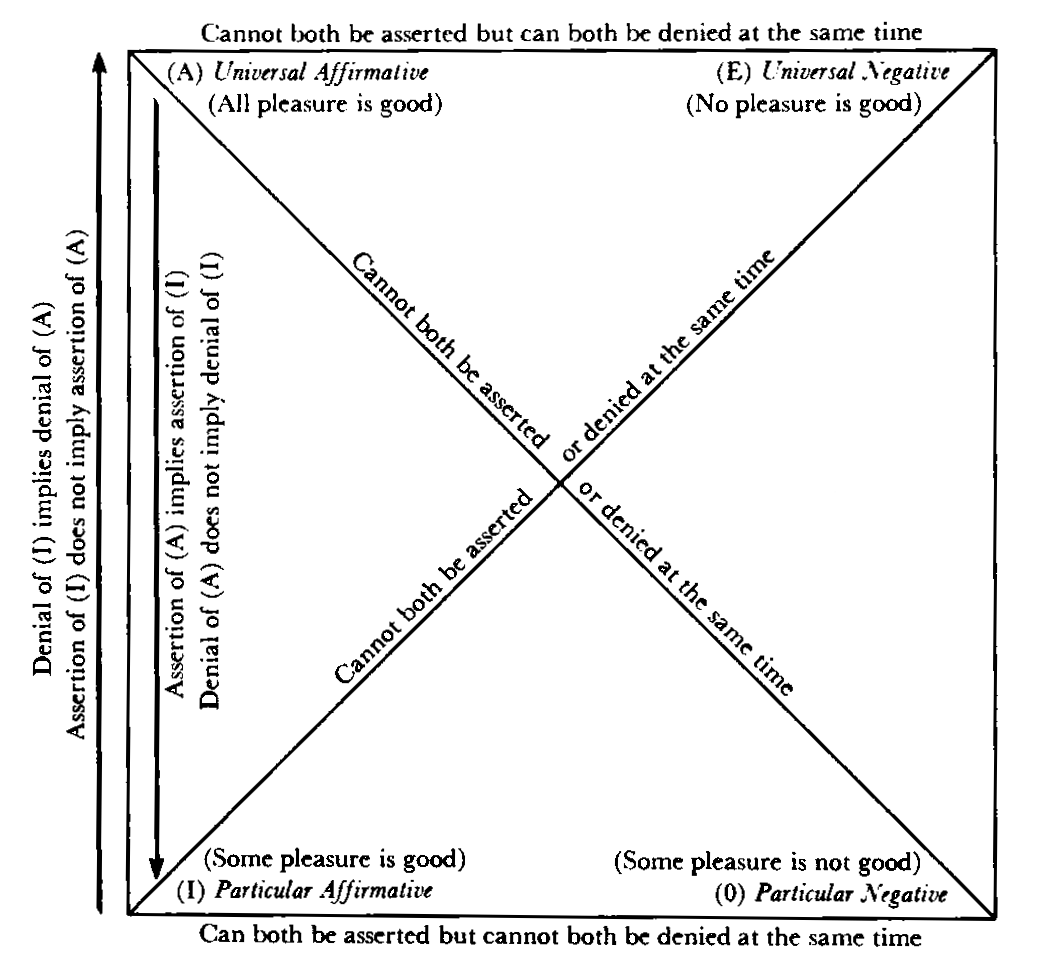
Again, if No pleasure is good is true, Some pleasure is good is false; and if No pleasure is good is false, then Some pleasure is good is true. → lat [403] Again, the assertion of a universal affirmative proposition necessarily implies the assertion of the corresponding particular; but its denial does not necessarily imply the denial of the corresponding particular. For if All pleasure is good is true, Some pleasure is good is necessarily true. But if we deny the first proposition and say it is not the case that all pleasure is good, it can still be true that some pleasure is good. Again, the assertion of a particular affirmative proposition does not necessarily imply the assertion of the corresponding universal, but its denial necessarily implies the denial of the universal. For if Some pleasure is good is true it does not follow that all pleasure is good; but if some pleasure is not good, then Every pleasure is good is false. You can observe this in the two remaining instances.
→ lat [404] When125 we have propounded a complete sentence with the purpose of deducing something from it, after it has been granted126 it is termed a premise. Another sentence should be joined to this sentence in a particular way, and of course this needs to be granted for the sake of what we want to infer; and when it has been granted, it is called a premise.
→ lat [405] From two premises rightly connected there results a conclusion. This conclusion cannot be called a premise, because you do not expect your opponent to concede it to you; rather, it follows despite his efforts, provided it has been inferred by keeping /144/ the rules. To make this clear by an example, let us suppose that the question is whether pleasure is advantageous. If we begin by asserting Every pleasure is good, we have a complete sentence; if our opponent grants this, it becomes a premise. When this has been conceded, the further sentence must be joined to it, Everything good is advantageous. If that also is granted, it becomes a premise; from these two premises there follows, despite our opponent, the conclusion: Therefore all pleasure is advantageous.
→ lat [406] The whole which consists of two premises and a conclusion is termed by us ratiocinatio and by the Greeks syllogismos. A syllogism, then, is the necessary progression from two or more conceded positions to one not conceded. There can therefore be more than two premises but there cannot be fewer. For it is a complete syllogism if we wish to reach what we desire to show (that pleasure is advantageous) by means of even three premises, as in Every pleasure is in accordance with nature; everything in accordance with nature is good; every good is advantageous; therefore every pleasure is advantageous. From this it is clear that even more premises may be added if appropriate.
→ lat [407] Sometimes we reach a conclusion by inferring not what follows directly from the premises but what necessarily follows from what we ought to infer; for example, Every virtue is good; everything good is advantageous; therefore every virtue is free from harm. The proper inference would be therefore all virtue is advantageous; but from that it necessarily follows that it is free from harm, because what is advantageous is never harmful. This is called by the Greeks symperasma and by us it can be called confinis conclusio [related conclusion].127
The syllogism, then, whether it has its own proper conclusion or a related conclusion, is divided into two kinds: the categorical and the conditional syllogism.
→ lat [408] A categorical syllogism is one in which the premises are connected in such a way that they are completed by something else added from outside, as in the example given above: Every pleasure is good; everything good is advantageous. We see here that not all that was in the first premise has been mentioned [in the /145/ second], but from the first premise one part, the predicate, has been taken and has become the subject in the second proposition. To form a complete sentence the second proposition has taken something from outside; namely, is advantageous. The conclusion is formed from the term which is added and the term which is not repeated; therefore every pleasure is advantageous.
This kind of syllogism has three figures.128 The first is the one in which the predicate of the leading premise becomes the subject of the subsequent premise, or the subject of the leading premise becomes the predicate of the subsequent one.129 The predicate of the leading premise becomes the subject of the subsequent one, for instance, in the example given above. The subject of the leading premise becomes the predicate of the subsequent one if you should wish to convert in the following way: Everything good is advantageous; every pleasure is good; therefore every pleasure is advantageous.
The second figure is that in which the predicate of the leading premise is also the predicate of the subsequent premise, as in Every virtue is good; no pleasure is good; therefore no pleasure is a virtue.
The third figure is that in which the subject of the first premise is also the subject of the subsequent one, as in Some good is a pleasure; every good is advantageous; therefore something advantageous is a pleasure.
→ lat [409] In the first figure a conclusion can be universal or particular, affirmative or negative; in the second figure no conclusion can be reached except negatively; in the third figure only a particular conclusion can be reached. There is, therefore, a point in keeping this order. For that figure is deservedly called first in which every /146/ kind of conclusion can be reached; and that is rightly called second in which a universal conclusion can be reached, albeit negatively; and that is rightly called third, being lesser in range, in which only a particular conclusion can be reached.
→ lat [410] I must now discuss how many moods130 each of these figures can have; these are restricted to a definite number and one should not lightly grant that any conclusion has been reached except in one of these moods. The first figure can have nine moods; the second, four; the third, six.
→ lat [411] In the first figure the first mood131 is that in which a universal affirmative is concluded directly from two universal affirmatives; for example, Everything just is honorable; everything honorable is good; therefore everything just is good. If you make the inference conversely therefore everything good is just, it does not follow; but one can make the particular inference therefore something good is just, and that forms the fifth mood.132 The second mood133 is that in which a universal negative is concluded directly from a universal affirmative and a universal negative; for example, Everything just is honorable; nothing honorable is base; therefore nothing just is base. If you convert therefore nothing* base is just, it forms the sixth mood.134 We have said above that a universal negative can be converted. The third mood135 is that in which a particular affirmative is concluded directly from a particular affirmative and a universal affirmative; for instance, Something just is honorable; everything honorable is advantageous; therefore something just is advantageous. But if you convert you form the seventh mood,136 therefore something advantageous is just, since it has been said /147/ above that the particular affirmative can be converted. The fourth mood137 is that in which a particular negative is concluded directly from a particular affirmative and a universal negative; for example, Something just is honorable; nothing honorable is base; therefore something just is not base. It cannot be converted, for we have said above that the particular negative cannot be converted. The eighth mood138 is that in which a particular negative is concluded conversely from a universal negative and a universal affirmative; for instance, Nothing base is honorable; everything honorable is just; therefore something just is not base. The ninth mood139 is that in which a particular negative is concluded conversely from a universal negative and a particular affirmative; for instance, Nothing base is honorable; something honorable is just; therefore something just is not base.
→ lat [412] Of the second figure the first mood140 is that in which a universal negative is concluded directly from a universal affirmative and a universal negative; for example, Everything just is honorable; nothing base is honorable; therefore nothing just is base. If you employ conversion here, the result is not another mood, since the conclusion is formed from the subjects of the two premises.141 The second mood142 is that in which a universal negative is concluded directly from a universal negative and a universal affirmative; for example, Nothing base is honorable; everything just is honorable; therefore nothing base is just. The third mood143 is that in which a particular negative is concluded directly from a particular affirmative and a universal negative; for example, Something just is honorable; nothing base is honorable; therefore something just is not base. The fourth mood144 is that in which a particular negative is concluded /148/ directly from a particular negative and a universal affirmative; for example, Something just is not base; everything evil is base; therefore something just is not evil.
→ lat [413] In the third figure the first mood145 is that in which a particular affirmative is concluded directly from two universal affirmatives; for example, Everything just is honorable; everything just is good; therefore something honorable is good. The second mood146 is that in which a particular affirmative is concluded directly from a particular affirmative and a universal affirmative; for example, Something just is honorable; everything just is good; therefore something honorable is good. The third mood147 is that in which a particular affirmative is concluded directly from a universal affirmative and a particular affirmative; for example, Everything honorable is just; something honorable is good; therefore something just is good. The fourth mood148 is that in which a particular negative is concluded directly from a universal affirmative and a universal negative; for example, Everything just is honorable; nothing just is evil; therefore something honorable is not evil. The fifth mood149 is that in which a particular negative is concluded directly from a particular affirmative and a universal negative; for example, Something just is honorable; nothing just is evil; therefore something honorable is not evil. The sixth mood150 is that in which a particular negative is concluded directly from a universal affirmative and a particular negative; for example, Everything just is honorable; something just is not evil; therefore something honorable is not evil. So all the moods keep to a fixed order, and the reason for the order is as has been shown in the figures themselves.151
→ lat [414] A conditional syllogism152 is one in which the initial /149/ premise contains both a full statement of the evidential proposition and a full statement of the demonstrandum,153 in such a way that when the evidential proposition has been taken as an additional premise the demonstrandum can be inferred with certainty. For instance, let us suppose the demonstrandum to be whether rhetoric is advantageous. As we wish to show that it is advantageous, let us form an evidential proposition from its definition, “the science of speaking well.” From this evidential proposition and the earlier demonstrandum a conditional syllogism is formed of which the first premise is If rhetoric is the science of speaking well, it is advantageous; as second premise we take the evidential proposition, But rhetoric is the science of speaking well. Whoever grants the truth of these two must grant, even against his will, that rhetoric is advantageous, which was in doubt before the first and second premises were granted. No term occurs in the second premise from outside the first, for that is a characteristic of the categorical syllogism. This is called by dialecticians the first mode, from antecedents,154 for the reason that the evidential proposition forms the second premise just as it occurs in the first, with the difference only that it occurs conditionally in the first and categorically in the second.
→ lat [415] The second mode, which is called from consequents,155 is one in which the evidential proposition follows the demonstrandum and not the other way round, for instance; If rhetoric is not advantageous, it is not the science of speaking well. The negation of the evidential proposition is taken as the additional premise, thus: But rhetoric is the science of speaking well; therefore it is advantageous.
/150/ → lat [416] The third mode is called from incompatibles.156 In this mode it is shown that it is not possible at the same time for one thing to be so and another not to be. When one of these two is asserted as an additional premise the other will necessarily be rejected, so that when the affirmative one is asserted the negative one is rejected. For example, It is not the case both that rhetoric is the science of speaking well and that it is not advantageous; but in fact it is the science of speaking well; therefore it is advantageous. Here the conclusion that it is advantageous is established by rejecting the negative disjunct in the first premise. These three modes can all be formed from one evidential proposition and they can all prove the one thing. In the first premise it makes no difference which part is put first, the evidential proposition or the demonstrandum, provided that the conditional form is preserved. When you say If rhetoric is the science of speaking well, it is advantageous, this can also be expressed as Rhetoric is advantageous if it is the science of speaking well. The same can be tried with the other two modes.
→ lat [417] The fourth mode is formed by disjunction157 in such a way that when the truth of one disjunct is granted, the other is necessarily denied; for example, Either he is healthy or he is sick; but he is healthy; therefore he is not sick.
→ lat [418] The fifth mode is also formed by disjunction in such a way that when one disjunct is denied the other is necessarily the case. For example, Either he is healthy or he is sick; but it is not the case that he is healthy; therefore he is sick.
→ lat [419] There are two further modes which can be formed through the evidential proposition used in the fourth and fifth, though not by disjunction but by negation. There is then a sixth mode, in which it is shown that two things cannot both be the case at the same time. The second premise is formed by the assertion /151/ of one, and the conclusion by the negation of the other; for example, It is not the case both that he is healthy and that he is sick; but he is healthy; therefore he is not sick. The seventh mode158 has the same initial premise as the sixth, but the same second premise and conclusion as the fifth. → lat [420] To enable the matter to be more easily understood, some formulas follow below, in such a way that their logical force may be appreciated through the facts themselves, not through stated examples. This is the formula for the first mode:159 If the first, then the second; but the first; therefore the second. For the second mode: If not the first, then not the second; but the second; therefore the first. For the third mode: Not both the first and not the second; but the first; therefore the second. For the fourth mode: Either the first or the second; but the first; therefore not the second. For the fifth mode: Either the first or the second; but not the first; therefore the second. For the sixth mode: Not both the first and the second; but the first; therefore not the second. And for the seventh mode: Not both the first and the second; but not the first; therefore the second.160
****→ lat [421] We must recognize that from one evidential proposition three of the above modes can be formed, and from a different one the other four. The reason for this order is so that the first mode may be the one called èèfrom antecedentsàà, because what is antecedent comes first; and the one called èèfrom consequentsàà is second, on the same principle, so that by its name it seems to show that it ought to follow the first in order. There remains the third one using the same evidential proposition, that èèfrom incompatiblesàà; for we cannot leap across to èèdisjunctionàà, since it cannot be formed from the same evidential proposition. This will therefore be the fourth mode, but, as it were, the first of those using another evidential proposition, and in that class the one which asserts its second premise affirmatively ought to come first; for affirmation is prior to negation. The fifth mode ought to be through disjunction also, but after the fourth because in the fourth the second premise is formed by affirmation, /152/ in the fifth by negation. This may be understood also in the two remaining modes.
→ lat [422] Syllogisms are combined in many ways, so that in one process of reasoning you may recognize the forms of both the categorical and conditional syllogisms. For example, if the question is whether dialectic itself is advantageous, the argument should be set out: èèIf it is advantageous to discuss well, the science of discussing well is advantageousàà; èèbut to discuss well is advantageousàà; èètherefore dialectic is advantageousàà. However, we must observe in the categorical syllogism what the second premise takes over from the first; for it is clear that it takes something from outside. But as I said, in what the second premise takes over from the first, we must note whether it takes it over correctly, in accordance with the patterns properly kept and remembered. For it happens that what was observed in the first premise to belong to the predicate, in the second premise clearly belongs to the subject; and again, if you form the second premise in a different way, the same phrase will belong to the predicate. For example, it is known that in the first figure the second premise is formed in such a way that either the predicate of the first premise is the same as the subject of the second, or else that the subject of the first is the predicate of the second; but in the second figure the predicates of the first premise and of the second are the same. So that if you were to advance an argument like this – èèEvery art is to be practiced by frequent exerciseàà; èèbut speech is the exercise of rhetoricàà; èètherefore rhetoric is to be practiced by frequent speechàà – then in the first premise exercise was seen to belong to the predicate, and in the second premise again it belongs to the predicate. Then how has the form been preserved? Surely, because something has been left in the predicate of the first premise which has not come into the predicate of the second, from which a conclusion could be formed; and that is, èèis to be practicedàà. For if I wished to form the second premise thus – Rhetoric is an art – the whole161 would be kept to form the conclusion: èèTherefore rhetoricàà /153/ èèis to be practiced by frequent exerciseàà. From this it is clear that there are many common elements which can be joined to either the subject or the predicate, according to the style of the second premise.”
→ lat [423] While Dialectic was holding forth in this way and getting on to matters as complicated as they are obscure, Maia’s son [Mercury] grew impatient and nodded to Pallas, who cut in:
“Madam, you speak with great skill; but now stop your exposition before you get entangled in the complexities of your subject, and its knotty problems exhaust the goodwill of Hymen. You have said in summary all that is fitting from that which learned discussion has contributed for the development of the subject in a large volume. A modest spring from deep learning is sufficient; it brings to light things hidden from sight, and avoids tedious discussion, without passing over anything and leaving it unrecognized. The matters that remain162 are founded on great deceit, and false deception encompasses those who are caught by them, while you prepare sophisms fraught with guile, or seductively make sport with trickeries from which one cannot get free. And when you gradually build up a sorites, or fashion errors which truth condemns, then your sin, your wicked deed, resounds in the ears of the Thunderer, since the lofty denizens of heaven hate everything false in a woman of shame. If you ponder it, what is more cruel than making sport of people? You have had your say, and you will surely become a disreputable and itinerant charlatan if you go on to build up your snares. Away then with shifty profundity, and leave what time remains to your sisters.”
→ lat [424] When Dialectic heard this she hesitated a little, but in obedience to the orders of the goddess she replied:
“I must respect your word, and in obedience to commands that I must honor I shall refrain and shall not say what I had commenced. But one indulgence should have been allowed me, that /154/ as a matter of honor I should have been permitted to refute the story which Bromius invented;163 he would then know that we daughters of Cccrops [i.c., women of Athens] know very well how to feel insulted; he would be able to see that I am more vipcrish than he had thought; his ‘clumsy Marsian’ would indeed become a magician; and he would not catch me asleep or drunk and babbling commonplaces when Jupiter’s stars are rising. But I must wait upon you alone, lady; I shall be quiet.”
With these words she fell silent, as if restrained, and many of the gods who had at first laughed at her trembled before her.
[Note a p. 106]
1 Cf. pseudo-Augustine De dialectica (Migne, PL, Vol. XXXII, col. 1415): Atque rectissime a dialecticis dictum est, ambiguum esse omne verbum. The writer has explained that any word can be put into all kinds of contexts (e.g., into questions on meter or history or poetry) and that until the utterance is complete a hearer cannot tell how to interpret any individual word. Pseudo-Augustine quotes Dialectic’s “school maxim” from a discussion in Cicero’s Hortensius, now lost. Torna al testo ↑
2 Cf. § 37, where Philology grows pale with nocturnal study. Torna al testo ↑
3 This refers to the sophism: “What you have not lost, you have; you have not lost horns from your head; therefore you have horns on your head.” See Diogenes Laertius 7. 187. Torna al testo ↑
4 A celebrated stoic philosopher of the third century b.c., author of numerous logical works, including a book on the sorites --- “the heap.” See Diogenes Laertius 7. 192. Cf. Persius 6. 80. Torna al testo ↑
5 Reading consumat with Dick. Some earlier editions prefer consummat [put the finishing touches to]. Torna al testo ↑
6 The sorites. Torna al testo ↑
7 Carneades, a skeptic philosopher of the second century b.c., is said to have used hellebore, a purgative drug, to make his mind keener and more subtle before disputing with Chrysippus (a chronological impossibility). See Valerius Maximus 8. 7. 5. Torna al testo ↑
[Note a p. 107]
8 The Latin here, deducti per quosdam consequentes gradus, applies equally well to a logical argument “deduced through certain successive steps” as to Dialectic’s symbolic hairstyle. Torna al testo ↑
9 Remigius remarks that this may refer to the requirements of a good definition; cf. § 340. More probably it simply refers to the rigor and completeness of logical argument. Torna al testo ↑
10 Formulae. The reference may be to inference patterns (schemata), or perhaps to certain attractive-seeming propositions which, when combined with further admissions (the hook), could lead to an opponent’s overthrow (the snake). Torna al testo ↑
11 Assumere, a common word for the granting of a proposition to serve as a premise in dialectical argument. Torna al testo ↑
12 Complexio, a philosophical term (Greek: symploké) for the interweaving of subject and predicate terms into a proposition; or, as here, for the union of premises in a syllogism. See also § 344, where it is translated as “embracing.” Torna al testo ↑
[Note a p. 108]
13 Martianus: Dumalibus hirta setis; cf. Ovid Metamorphoses 13, 850: Hirtae... saetae. The word dumalis is not found elsewhere in Latin. Torna al testo ↑
14 This is the meaning of Dick’s text following the better manuscripts. One manuscript reads hirsuti, which would be translated as “her cloak [rather than complexion] was dark and covered with thick, prickly hair.” Torna al testo ↑
15 See § 401. Torna al testo ↑
16 This sentence remains opaque. If vertier (here translated as “reversed”) means “converted” rather than “overthrown,” the first part taken alone is nonsense, since it is precisely these two kinds of propositions which cannot be converted simpliciter. In this case, the second part (“connecting ambiguous terms to univocal terms”) may refer to some fallacious way of effecting the conversions. If vertier means “overthrown,” there may be a reference to the “fallacy of four terms,” where an ambiguous middle term is used in different senses in the premises of a syllogism. It is hard not to suspect the text. Torna al testo ↑
17 Cf. Cicero Academica 2. 91. Torna al testo ↑
18 See Raymond Klibansky, “The Rock of Parmenides,” Mediaeval and Renaissance Studies, I (1941-1943), 178-86. The original text may, however, have had urbe [city] instead of rupe [crag]. Torna al testo ↑
19 Martianus: Cum... anguis assurgens allambere feminam crebris linguarum micatibus attemptaret; cf. Silius Italicus Punica 6. 223: Lingua micat motu atque assultans aethera lambit. Torna al testo ↑
20 Martianus: ex harenis Libyae anhelantis; cf. Lucan Pharsalia 1. 368: per calidas Libyae sitientis harenas. Torna al testo ↑
[Note a p. 109]
21 The Marsi, an Italian tribe, had a reputation for sorcery, poisoning, and snake-charming; see Horace Epodes 17. 29; and Satires 1. 9. 29; Pliny Natural History 25. n; Silius Italicus Punica 8. 495-501. The reputation may originate in their claim to be descended from Circe; see Pliny Natural History 7. 14-15. Torna al testo ↑
22 Cf. § 424. Torna al testo ↑
23 Athena bore the representation of Medusa’s head on her shield to commemorate her slaying of the Gorgon (Euripides Ion 989-97) or her part in helping Perseus to do so (Lucan Pharsalia 9. 655-77). See H. J. Rose, A Handbook of Greek Mythology, (London, 1958), pp. 30 271-72. Torna al testo ↑
24 A commonplace in Latin philosophical writing. Cf. Lucretius De rerum natura 1. 136-39; Cicero Academica 1. 18; Seneca Epistles 58. 1. Torna al testo ↑
[Note a p. 110]
25 The words nam at the beginning of this sentence and quis dubitat at the end in Dick’s text should be omitted. See Jacobus [Janies A.] Willis, De Martiano Capella Emendando (Leiden, 1971), p. 28. Torna al testo ↑
26 Rhetoric. Torna al testo ↑
27 Geometry. Torna al testo ↑
28 The terminology of the first four divisions: de loquendo, de eloquendo, de proloquendo, de proloquiorum summa is found also in the book De dialectica attributed to Augustine, and is almost certainly Varronian. The first four divisions correspond to Aristotle’s works on logic, the remaining two to his Poetics and Rhetoric. Torna al testo ↑
[Note a p. 111]
29 I.e., taken as identical with these parts. Torna al testo ↑
30 Sections 344-54 correspond in subject matter to Porphyry’s (3d cent. a.d.) to Aristotle’s Categories and deal with what came the quinque voces [the five terms, or predicables]. This became order of exposition among the medieval logicians. Torna al testo ↑
[Note a p. 112]
31 The word forma is regularly used by Martianus for our “species”; cf. § 345. In this translation it is usually rendered as “species,” except in this and the following paragraph. Torna al testo ↑
32 That is, the definition and name of the genus can be truly predicated of the species. Corporeal living being (corpus anima participans: lit., “body sharing in soul”) is here taken as the definition of animal. Cf. Plato Timaeus 77b. Torna al testo ↑
33 Martianus here makes no distinction between differentia meaning “any difference” and meaning “a specific difference” based on a comprehensive scheme of classification. In § 353, however, only the latter meaning will make sense of the passage. Torna al testo ↑
[Note a p. 113]
34 The inclusion of “two-footed” in the list two sentences later suggests that a division based on numbers of feet may have been dropped from the text here. Torna al testo ↑
35 The phrase limiting accident to a given species seems unique to Martianus. Normally black and white would be understood as accidental qualities of man, but of course they apply to many other kinds of things as well. Martianus was perhaps trying to bring his definition into symmetry (however false) with the definition of property; and his example did nothing to make his error evident. Torna al testo ↑
36 I.e., proprium [peculiarity]. Torna al testo ↑
[Note a p. 114]
37 This definition is a commonplace. Sec, e.g., Apuleius Peri hermeneias 271 (ed. Thomas, p. 182, line 12); pscudo-Augustine De dialectica 9 (Migne, PL, Vol. XXXII, col. 1416). It introduces an inconsistency, however, with Martianus’ /115/ claim three sentences earlier that all animals are mortal. If animal is defined in this way, the distinction between man and the gods becomes unnecessary. Torna al testo ↑
[Note a p. 115]
38 Division in the technical sense, where it applies to a species or a genus but not to an individual, corresponds to our subdivision. Torna al testo ↑
39 Here, as in many other places, Martianus’ preoccupation with dialectic as the practical art of disputation, rather than as the theoretical study of formal logic, is evident. Torna al testo ↑
40 Differentiae, interpreted in a narrower sense than in § 346. Martianus does not, of course, mean that there are no differences between the right arm and the left leg, for example, but that in dealing with the parts of a whole it is easier to deal with the individual parts than with groupings of parts. Such groupings as might occur to us – limbs, organs, vessels and so on, – are not based on a full scheme of classification which is at once exclusive and exhaustive. To draw up /116/ one, and so determine the right distinguishing characteristics for each group, would be “impossible, or else a very long task.” Torna al testo ↑
[Note a p. 116]
41 I.e., can have the name and definition of man truly predicated of them. Torna al testo ↑
42 The Aristotelian tradition settled on no definition of man as the correct one. For purposes of illustration, as here, any plausible definition would do. Torna al testo ↑
43 The next two paragraphs are derived ultimately from the opening of Aristotle’s Categories. However, the resemblances are much greater to the logical works attributed to Augustine. In Martianus the technical terms are given in a Latin form (aequivoca [equivocals], univoca [univocals]), whereas in pseudo-Augustine they are given in the Greek form used by Aristotle (homonyma, synonyma). As Aristotle was concerned with the things signified, rather than with the words that signified them, he has no term corresponding to Martianus’ plurivoca [plurivocals], which pseudo-Augustine calls polyonyma. In the second sentence of § 355 compare Martianus: ut leo... verus et pictus with pseudo-Augustine De decem categoriis 2 (Migne, PL, Vol. XXXII, col. 1421): ut homo... pictus et verus. Torna al testo ↑
[Note a p. 117]
44 Reading: ergo hoc univocum in generibus esse intelligitur, quae et nomen et definitionem dant formis suis. See Willis, pp. 29-30. Torna al testo ↑
45 Martianus: quando multis nominibus una res dicitur, ut gladius: nam et ensis et mucro idem significant; cf. pseudo-Augustine (as cited above, n. 43): cum multa nomina unam rem significant... ut ensis, mucro, gladius. The same example, without the technical term, is found in Quintilian Institutiones Oratoriae. 10. 1. 11 ff. Torna al testo ↑
46 With §§ 358-60, cf. §§ 509-12. Torna al testo ↑
47 The expressions quoted are everyday Latin idioms, used, as Cicero remarks (Orator 80-81), even by countryfolk. The examples are standard; cf. also Cicero De oratore 3. 155; Quintilian Institutiones Oratoriae 8. 6. 6; Julius Victor oRhetorica 20 (ed. Halm, p. 431). Torna al testo ↑
48 The structure and content of this paragraph correspond closely to the similar treatment in pseudo-Augustinc. Martianus: per similitudinem... ut verborum habeant propinquitatem,... per contrarium, per differentiam; cf. pseudo-Augustine De dialectica 6 (Migne, PL, Vol. XXXII, col. 1412): Vocabulum translatam... similitudine,... quadam vicinitate... bine progressio... usque ad contrarium. Torna al testo ↑
[Note a p. 118]
49 A derivation from parcere [to spare] is assumed by Martianus. In fact, their name is derived from a root which means “to weave” (cf. plico) and refers to their function of weaving the web of life. Torna al testo ↑
50 Martianus: Lucum, cum non luceat; cf. pseudo-Augustine (as cited in n. 48): Lucus... quod minime luceat. The derivation from lux [light] is probably correct, but not the explanation. Originally the word may have referred to a clearing. Torna al testo ↑
51 The exposition from here to § 387 is based ultimately on the Categories of Aristotle. Some small sections read like a literal translation of the Greek, but a great deal of Martianus’ account reads like an expanded paraphrase of certain sections of Aristotle. One suspects that Martianus is following a commentator rather than the original text, whether in Greek or Latin translation. Sec Lorenzo Minio-Paluello, “The Text of the Categoriae: The Latin Tradition,” Classical Quarterly, XXXIX (1945), p. 66. Torna al testo ↑
52 This is a commentator’s attempt to improve upon Aristotle, to make his classification of “things there are” (Categories ia 20) into a classification of terms. Torna al testo ↑
53 This opaque terminology is abbreviated from Aristotle’s “said of” and “[present] in.” J. L. Ackrill explains this well: “What is ‘said of’ an individual, X, is what could be mentioned in answer to the question ‘What is X?’, that is, the things in direct line above X in the family-tree, the species (e.g. man or generosity), the genus (animal or virtue), and so on” (Aristotle’s ‘Categories’ and ‘De Interpretatione, trans, with notes by J. L. Ackrill [Oxford, 1963], p. 75). /119/ Ackrill similarly explains (p. 74) that what are “present in” a subject are individuals in categories other than the category of substance: “Presumably Aristotle has in mind the occurrence in ordinary Greek of locutions like ‘heat in the water’, ‘courage in Socrates’.” Martianus’ four classes are thus (i) subjects – that is, individuals in the category of substance; (ii) species and genera in the category of substance; (iii) individuals in the other categories; (iv) species and genera in the other categories. Torna al testo ↑
[Note a p. 119]
54 Dick’s text here reads: Subiectum est prima substantia, quod... [A subject is a primary substance which... ]. The words “primary substance” spoil the exposition and are probably a gloss such as I have given in the preceding note. Torna al testo ↑
55 Aristotle himself gives no explanation of this phrase. Torna al testo ↑
56 This contradicts the possibility envisaged by Aristotle in Categories 2a 28 ff. The change may reflect the greater ease with which Latin forms abstract nouns. Thus the category member would be termed, for example, “whiteness” (candor), rather than simply “white” (to leukon) as in Greek. Torna al testo ↑
57 Martianus omits Aristotle’s further condition that what is in a subject must not be a part of the subject. The exemplification which follows is not due to Aristotle. Torna al testo ↑
[Note a p. 120]
58 Martianus’ attempt to show the dependence of each of the other categories upon substance does not correspond to anything in Aristotle’s preliminary listing and exemplification of the categories (Categories 1b 25 ff). Pseudo-Augustine reflects a critical tradition in which quality, quantity, and attitude are in a substance, whereas place, time, and state are separate from substance (De decem categoriis 8; Migne, PL, Vol. XXXII, col. 1425). Torna al testo ↑
59 Martianus means that some correlates have no names: the understanding comes before the word, which may have to be coined. Cf. § 379, and Aristotle Categories 7a 5. Torna al testo ↑
60 Lit., “this happens to (is an accident of) Rome itself.” Presumably Martianus means that one can say X is in Rome only if something has happened to Rome; namely, that X is there. It is far from clear that Rome would be considered a substance by Aristotle, however. A serious Aristotelian point might be made that although there might be positions (i.e., points in space) without there being substances, we could not specify the coordinates for any position without reference ultimately to some material object (i.e., substance). Torna al testo ↑
61 The words for attitude and state are quite general in both Greek and Latin. Aristotle’s examples, given also by Martianus, show that he conceived of the categories with a particular man as subject, and of these categories with the narrow meanings of “posture” and “clothing.” The Latin terms could equally well be so translated here. Torna al testo ↑
[Note a p. 121]
62 The addition of “inseparably” to Aristotle’s definition (Categories 2a11), and the justification which follows, is due to a commentator. Aristotle had already explained that whatever is in a subject is incapable of independent existence (a point against Plato’s Ideas), and Martianus had included this in § 362. Torna al testo ↑
63 Aristotle may hint (Categories 8b 15), but he does not say, that parts of the body are capable of independent existence. His doctrine in other passages (Metaphysics 1035b 23; De anima 412b 20, Politics 1253a 20) is that a hand, for example, in separation from the organism of which it is a part, is not strictly a hand at all. Torna al testo ↑
64 Again, this section reads as if made up of short quotations from Aristotle interleaved with longer sections of commentary. Torna al testo ↑
[Note a p. 122]
65 Sections 367 and 368 read like a condensed version of Aristotle, except that Martianus’ second species of quality is Aristotle’s third, and vice versa. The discussion of athletic in § 369, however, is a commentary on Aristotle’s Categories 9a 14 ff. and 10a 34 ff. Torna al testo ↑
[Note a p. 123]
66 Aristotle too appears to exclude temporary affections (or “passions”) from the category of quality; e.g., in Categories 10a10. His introduction to the subject (9a 28) shows, however, that this is not necessarily his intention. Martianus or his source (cf. Ackrill, pp. 106-7) takes the defining phrase “said to be of such and such a kind” as referring to permanent characteristics, and so appears to exclude temporary affections completely. Torna al testo ↑
67 palaestricum --- lit., “capable of wrestling.” Torna al testo ↑
68 The example has been well adapted for Latin. In Greek, “good” (agathos), with a different stem from that in the word “goodness” (arete), is a sufficient example. Aristotle had earlier made the point, needed for clarity, that most terms of qualities which are predicated of substances are named derivatively from the qualities themselves. For instance, when we say X is generous the term generous is derived from the quality generosity. But sometimes the words do not have the same derivation, or (as with the word translated as athletic) a suitable noun for the quality may not be available. Torna al testo ↑
[Note a p. 124]
69 The last two examples are not found in Aristotle, and their propriety is questionable. Torna al testo ↑
70 This sentence is omitted in one manuscript, and Dick proposes its exclusion “not unwillingly as an inept gloss.” Perhaps, however, the sentence reflects a Stoic critique of Aristotle’s claim (Categories na 1) that “undoubtedly... one man is called... more just than another.” Torna al testo ↑
71 It is not clear whether substance here means the subject in which the qualities inhere (for example, the man who is just); or the quality itself (for example, justice). The context suggests the latter, but the meaning is probably the former. Martianus, or his source, has finished his discussion, based on Aristotle, Categories 10b 26-11a 14, of the extent to which qualities admit of degrees, and he now restates the doctrine of § 365. Torna al testo ↑
72 Like the section on quality, Martianus’ discussion of the category quantity reads largely like an abridgment of Aristotle. In § 373 only one of Aristotle’s several examples is given, but this is elaborated with explanatory commentary. Torna al testo ↑
73 Aristotle explains (Categories 4 32) that spoken language is a quantity, being measurable into long and short syllables. Aristotle’s procedure in his whole chapter on quantities is strange, in that he is concerned not so much with quantitative predicates (e.g., two-feet-long) as with a classification of the primary things which are quantitatively measurable (e.g., lines). It would seem that he /125/ has either glossed over or rejected the distinction made in the preceding sentence, partly because of a desire to avoid classing lines, etc. as substances. Speech, presumably, is the primary owner of such quantitative predicates as iambic, dactylic, and so on. Torna al testo ↑
[Note a p. 125]
74 That is, these belong to the category of relation. Torna al testo ↑
75 The final clause corresponds to nothing in Aristotle, but is strikingly like Ackrill’s comment (p. 98) on the same passage: “an examination of the uses of ‘equal’ and ‘unequal’ (in Greek or English) soon shows the inadequacy of this as a distinguishing mark of those things Aristotle counts as quantities.” Torna al testo ↑
[Note a p. 126]
76 The Latin translates Aristotle’s Greek literally, and fails to observe that the Greek genitive (“of”) also covers the “than” of comparison. The first sentence of the following section makes an adaptation for Latin. Torna al testo ↑
77 The standard correlative of double is half. This unusual use of single as the correlative is found also in pseudo-Augustinc De decem categoriis 11 (Migne, PL, Vol. XXXII, col. 1431), but with the simple genitive (“the double of the single”) instead of with ad (“double in comparison with the single”). Cf. § 384. Torna al testo ↑
[Note a p. 127]
78 Unlike Aristotle, Martianus repeats what has already been shown (§ 372). Torna al testo ↑
79 Dick reads non posse [cannot] although several good manuscripts omit the negative. Its omission or inclusion makes no difference to the final meaning, since the word corresponding to “this” in the original text may refer either to a subject’s being able to be both A and B at once or to its being unable to be both A and B. See Willis, p. 31. Torna al testo ↑
80 The second half of this sentence is simple-minded commentary on Aristotle’s text. Torna al testo ↑
81 Reading alicuius for the unintelligible iam quis equus rightly bracketed by Dick. Rhoebus (or Rhaebus) was the horse of Mezentius in Vergil Aeneid 10. 861. It is interesting to note Martianus’ consistent use of Roman examples – such as Cicero, where the Greeks cited Socrates or Callias. In the passage corresponding to this one (Categories 8a 13 ff.), Aristotle speaks only of “some individual man” and “some individual ox.” In Greek examples horses were often named /126/ Xanthus, a name which belonged to horses of Hector and Achillas in the Iliad. See, for instance, pseudo-Augustine De decem categories 1 (Migne, PL, Vol. XXXII, cols. 1419-20). Torna al testo ↑
[Note a p. 128]
82 This opaque explanation largely misses Aristotle’s point. Rhoebus, qua horse, is not necessarily someone’s horse; but qua property he is necessarily someone’s property. The substitution of “beast of burden” for Aristotle’s “property” (Categories 8a 24) is less than helpful. Torna al testo ↑
83 This section is confused in the present state of the text. I believe that the words in square brackets cannot possibly belong where they are, since a reference to secondary substance disrupts the clear order of the passage; primary substances, parts of primary substances, secondary substances, parts of secondary substances. Moreover, the example of nonreciprocating terms which follows is still clearly concerned with the particular hand of Cicero, not with a hand in general (manus specialiter).It seems best simply to omit the bracketed words, and to understand them as a gloss on manus specialiter later, thus: “Therefore the question arises, What of the parts of secondary substance? There is no question about a substance itself, for a man is not a man of anyone. But a hand in its general character as a hand (not his hand, but in its general character as a hand, so that it would be a secondary substance) is the hand of some man.... ” Martianus is using the following classification: Cicero as a primary substance; Cicero’s hand (manus eius) as a part of a primary substance; man as a secondary substance; a hand qua hand (manus specialiter) as a part of a secondary substance. Torna al testo ↑
[Note a p. 129]
84 The deficiencies of Martianus’ arrangement as against Aristotle’s are evident when one realizes that the content of § 379 is here assumed. Torna al testo ↑
85 This is a major departure from Aristotle, who does not allow that parts are in a whole, in his use of in. Martianus’ revision of the definition of relatives equivocates between the uses of in, since servitude is not in a slave in the same way as his foot is in him. Aristotle’s own revision (Categories 8az8 ff.) of the definition is not clear either, and has generated much discussion, both in antiquity and now. It seems, however, that Aristotle saw the possibility of forming reciprocating relationships (if necessary, by coining words) as a necessary but not sufficient condition for being a true relative. He then introduces an epistemological condition as well: can we definitely know, for example, that this is a hand without knowing what it is the hand of? If so, we are not compelled to see it as a relative in any important sense. See Ackrill, pp. 101-3. Torna al testo ↑
[Note a p. 130]
86 The bracketed clause is an attempt to give a translation of the words ut /131/ eius sit [so that it is of it]. Willis would delete these words, on the grounds that they are repeated from the preceding sentence, a simple and common form of corruption. The sense of the example requires an example of relationship to something, not of something, which would be the prima-facie meaning of the words. See Willis, p. 31. Torna al testo ↑
[Note a p. 131]
87 The examples which follow form a commentary on Aristotle’s text. Torna al testo ↑
88 The rather fulsome distinctions between various kinds of opposites are abbreviated from Aristotle’s own account (Categories 1b 16 ff.). Torna al testo ↑
[Note a p. 132]
89 This sentence of summary is not found in the best manuscripts, and it confounds distinctions that have been made by the author. It should be deleted from the text. See Willis, p. 32. Torna al testo ↑
90 l e., combined into complete utterances – in this case, propositions which are necessarily either true or false. In the standard exposition, found first in Aristotle (Categories 1a 16 ff.) and later, for example, in pseudo-Augustine De dialectica I (Migne, PL, Vol. XXXII, col. 1409), the distinction between single and combined terms is explained earlier. In Martianus it is implied in the verse prologue of Book IV (§ 327, associum), but not made explicit until § 388. The final sentence of § 387 suggests some uneasiness on his part over the matter. Moreover, Martianus does not say explicitly that the proposition which results /133/ when terms are combined is subject to truth or falsity, whereas single terms (whether relatives, contraries, or whatever) cannot be either true or false. The distinctions he goes on to make are based on Aristotle’s further investigations into the differences between contradictory propositions, on the one hand, and the propositions resulting when relatives and contraries are combined with a subject, on the other. The doctrines which relate the truth value of propositions to the existence or nonexistence of the subject are found in Aristotle (Categories 13b 15 ff.), but are hardly satisfactory. Aristotle himself acknowledges (De interpretatione 21a 25 ff.) that Homer is a poet does not entail Homer is. Torna al testo ↑
[Note a p. 133]
91 Reading: ut ‘stultus est ille’ et ‘sapiens est ille.’ See Willis, p. 34. Torna al testo ↑
92 Again, Martianus should say “from propositions predicating privation and possession.” Torna al testo ↑
93 At this point Martianus turns from the Aristotelian Categories, after discussing only one of the miscellaneous topics which close that work: opposites, priority, simultaneity, change, and having – the so-called postpraedicamenta. The topics which follow in Martianus correspond in structure to the Aristotelian treatise De interpretatione, which deals with such things as name, verb, sentence, proposition, affirmation, and negation, as well as relationships between statements (Aristotle goes on to a discussion of modality, which has no counterpart in Martianus). In detail, however, the links with the De interpretatione are far weaker than those with the Categories. The connections with pseudo-Augustinc s De dialectica, and so presumably with a lost work by Varro, are much stronger. In the systematic exposition adopted by both Augustine and Martianus, we now turn to the second part, De eloquendo [On complete utterance]. Torna al testo ↑
[Note a p. 134]
94 Martianus means the first-person form of the verb, which in Latin is usually a single word. The subject matter of this and the following section is fuller than that of the corresponding opening of the pseudo-Augustinian treatise, De dialectica I (Migne, PL, Vol. XXXII, col. 1409) but is clearly related to it. Torna al testo ↑
95 In figures of speech – personification and apostrophe. Torna al testo ↑
96 Martianus, like other Latin or Greek writers, assumes that what we call “impersonal’’ verbs of weather are really personal verbs with the appropriate god as subject. Cf. pseudo-Augustine De dialectica I: “An exception [to the rule that a Latin third-person verb form is not a complete utterance] is such verbs in which there necessarily inheres a signification of the person by custom of speech; for instance, when we say It is raining or It is snowing, even if there is not added who is raining or snowing. Nevertheless, because this is understood, these cannot be counted among simple utterances.” Torna al testo ↑
[Note a p. 135]
97 The allowance of some propositions as doubtful is a weakness, based on a failure to understand the difference between a proposition and the sentence which expresses it. Ille disputat [He is discussing] is not a proposition but a propositional function, equivalent to X is discussing, where X is a variable to be filled at will. Ille here stands for the Stoic ekeinos, which was precisely such a variable; see William and Martha Kneale, The Development of Logic (Oxford, 1962), p. 146. Martianus or his source would appear to have conflated the standard Aristotelian dichotomy of propositions into true and false with the Stoic classification of axiomata into definite and indefinite. Torna al testo ↑
98 This paragraph continues the confusions alluded to in the previous note, and adds a further, more serious one. The truth or falsity of a proposition does not depend on our judgment. The dubiety of X is discussing has to do with what is said, not with how it seems to us. The proposition A sponge is an animal may be “doubtful” to us and at the same time true. Torna al testo ↑
99 "The “it” of this translation is to be understood without reference to some particular thing which is being discussed. This Latin impersonal passive is equivalent rather to “discussion is taking place.” Torna al testo ↑
[Note a p. 136]
100 Dick’s text here mistakenly prints quaesto for quaestio. Torna al testo ↑
101 Dick proposes exclusion of this sentence. He ought to propose exclusion of the following one as well, or of neither. The two sentences together are a gloss, possibly Martianus’ own, to guard against misunderstanding of the previous utrum currat [whether he runs], which can also mean “He is to run” or “He ought to run.” Torna al testo ↑
102 Lit., “the optative mood.” Mention of an optative mood seems curious in Latin, and suggests an ultimate Greek source. Some manuscripts of pseudo-Augustine (De dialectica 2), however, give an archaic Latin optative form, di ilium perduint, in the corresponding example. Torna al testo ↑
103 Reading: non necessaris facit proloquium si nihil est, quod icon et affirmari et negari protest, et supra diximus multa dici plena sententia quae tamen affirmari < et negari non possint, quaestionem vero nasci ex eo, quod affirmari > possit et negari possit. See Willis, p. 35. Torna al testo ↑
[Note a p. 137]
104 This curious sentence should be understood as having “every man” as the subject. Despite Martiamis’ claim of what order is “natural,” the inverted sentence is far more natural in Latin than in English. Torna al testo ↑
105 This sentence, which cannot be adequately translated into English, explains the choice of terms par subiectiva [part laid down] and pars declarativa [part declared]. These terms are characteristic of Apuleius’ Peri hemteneias. Torna al testo ↑
106 The phrase falsitati et veritati obnoxius [subject to truth and falsity] is /138/ characteristic, with minor variations, of Apuleius and pseudo-Augustine, and may well be due ultimately to Varro’s discussion of the proloquium [proposition]. Torna al testo ↑
[Note a p. 138]
107 Martianus’ discussion of the third part De proloquendo [On the proposition], while still corresponding in outline to part of Aristotle’s De interpretatione, has very close affinities with the treatise Peri hermeneias, attributed to Apuleius. This is the probable source both for this section and also for the account of the categorical syllogism which follows. Torna al testo ↑
108 Latin syntax permits an ambiguity which is not possible in English. Martianus’ example, homo ambulat, can mean either “Man walks” (a general proposition) or “A man is walking” (a particular proposition); hence it is called indefinite. He then goes on to give a rule of safe (i.e., minimal) interpretation, for if the general proposition is true so is the particular, but not necessarily conversely. Cf. Aristotle De interpretatione 17b 5-l3; Apuleius Peri hermeneias 266 (ed. Thomas, p. 177, lines 14 ff.). Torna al testo ↑
109 Dedicativa and abdicativa are technical terms characteristic of Apuleius, and so are found also in Cassiodorus. Torna al testo ↑
110 Omnis voluptas non est bonum. This sentence is to be understood as asserting that all pleasure is other than good, that is, that no pleasure is good. But in normal English the form All pleasure is not good is equivalent to a negative particular rather than to a universal. For this reason expressions of this type are translated by the form No pleasure is good throughout this section, with an exception toward the end of § 397. Torna al testo ↑
[Note a p. 139]
111 Martianus here, and in several other places, uses the feminine gender rather than his usual neuter. This suggests that propositio rather than proloquium is to be understood, and is thus a further link with Apuleius’ Peri hermeneias. The use of the diminutive particula [term] in the next sentence is characteristic of the same work. Torna al testo ↑
112 In reintroducing the five predicables here, Martianus follows Apuleius (Peri hermeneias 270-71; ed. Thomas, p. 182, lines 4-20), who gives the same examples as Martianus used in §§ 344-49. From the standpoint of formal logic this is irrelevant, since the question of what is a property, for example, of a given subject cannot be answered without empirical investigation. Martianus’ account reads like an expanded explanatory paraphrase of Apuleius’ account. Torna al testo ↑
113 intendere. Willis suggests intellegere; the sense would then be “we ought to understand.” Torna al testo ↑
[Note a p. 140]
114 The last part of this paragraph is strange. It appears somehow related to Apuleius’ cryptic conclusion to his account of the role of the five predicates in conversion: igitur per haec agnoscetur particularis abdicativa non esse conversibilis [Therefore it will be recognized through these (sc. five predicates) that the negative particular is not convertible]. Whatever the justification for Apuleius’ curious demonstration may be, it seems that Martianus has misunderstood it – in particular, the words non esse. Could his text have had abdicative, giving the meaning “the nonbeing of a particular negative is convertible”? Torna al testo ↑
115 The Latin of this example (quiddam risibile non est praeter hominem) is far less strained than the translation given, which is intended to show how Martianus apparently construes a sentence which would normally mean: “Anything other than man which is capable of laughter does not exist.” Torna al testo ↑
116 In more recent terminology this is known as contraposition (or, more precisely in the first example, an obverted form of contraposition). Torna al testo ↑
117 Cicero De inventione 1. 13. Martianus follows a common ancient practice in calling the De inventione the Rhetorica. The example has no counterpart in Apuleius. Torna al testo ↑
[Note a p. 141]
118 I.e., before conversion. For the text: ut ubi non est negatio... sit, see Willis, p. 36. Torna al testo ↑
119 The second part of this sentence is either very cryptic or else a simple mistake. The universal negative is the only proposition which will allow of both simple conversion and contraposition. Only the particular affirmative will not allow of contraposition. Apuleius has nothing corresponding to Martianus’ statement. Torna al testo ↑
120 Martianus: Haec autem proloquia quemadmodum inter se affecta sint hoc modo manifestius apparebit. quattuor lineis quadrata formula exprimatur. Cf. Apuleius Peri hermeneias 268. (ed. Thomas, p. 179, line 17): Numc dicendum est, quemadmodum quattuor illae propositiones inter se affectae sint, quas non ab re est in quadrata formula spectare. Both the similarities and the differences of diction between Martianus and his probable source are characteristic of this whole section. Martianus does not give technical terms for the relations exhibited by the square. Apuleius’ discussion of the square comes before his discussion of conversion. Torna al testo ↑
121 In standard terminology these are “contraries” (Apuleius: contrariae). Torna al testo ↑
[Note a p. 142]
122 The form of statement used by Martianus, in which the initial non negatives the entire proposition and is translated as “it is not the case that... ” is characteristic of Stoic logic; Apuleius Peri hermeneias 267 (ed. Thomas, p. 177, line 26); Benson Mates, Stoic Logic (Berkeley, 1961), p. 31. Torna al testo ↑
123 Reading: nam utique non potest simul ‘non quaedam voluptas bonum’ et ‘non quaedam voluptas non bonum’ esse. This reintroduces a double negative excluded by Willis (p. 37) following the better manuscripts, but accords better /143/ with the context. The sense is clear, but the text demands further consideration. The propositions in question are subcontraries (Apulcius: subpares). Torna al testo ↑
[Note a p. 143]
124 These are “contradictories” (Apulcius: alterutrae). Torna al testo ↑
125 Here begins Martianus’ fourth part, De summa proloquiorum [On the syllogism]. Torna al testo ↑
126 I.e., by an opponent. The subordination of logic as a pure science to practical debating, already seen in the naming and description of Dialectic, is here evident again. Torna al testo ↑
[Note a p. 144]
127 Martianus’ term means literally “neighboring conclusion”; i.e., “conclusion one step removed.” Torna al testo ↑
[Note a p. 145]
128 Modern textbooks recognize four figures. The recognition of the fourth is attributed to Galen, but was not usually indicated in textbooks until comparatively modern times. As Martianus does not distinguish between the major and minor premises, his characterization of the first figure is able to include the fourth. Of his nine valid moods of the first figure, only four are now usually classed as belonging to it; the other five belong to the fourth. For a full account, see Nicholas Rescher, Galen and the Syllogism (Pittsburgh, 1966), esp. pp. 13-15, 22-49. Torna al testo ↑
129 The two possibilities arise because the order of the premises is immaterial to the validity of the conclusion. It has long been conventional, however, to state the major premise (that which contains the predicate term of the conclusion) first. In Martianus’ examples the minor premise is often given first. Torna al testo ↑
[Note a p. 146]
130 Martianus lists only the nineteen valid moods, not all the possible moods of the figures. In the Middle Ages these nineteen were given mnemonic names which are still used and are indicated in the notes. In these names the vowels indicate the kinds of propositions in the premises (i.e., the A, E, I, O propositions according to standard terminology, where, for instance, A - universal affirmative) when the major premise is placed first. Martianus gives the premises in the reverse order. Torna al testo ↑
131 Barbara. Torna al testo ↑
132 Baralipton, corresponding to Bramantip in the fourth figure. Torna al testo ↑
133 Celarent. Torna al testo ↑
134 Celantes, corresponding to Canenes in the fourth figure. Torna al testo ↑
135 Darii. Torna al testo ↑
136 Dabitis, corresponding to Dimaris, in the fourth figure. Torna al testo ↑
[Note a p. 147]
137 Ferio. Torna al testo ↑
138 Fapesmo, corresponding to Fesapo in the fourth figure. Torna al testo ↑
139 Frisesomorum, corresponding to Fresison in the fourth figure. Torna al testo ↑
140 Cesare. Torna al testo ↑
141 The converse conclusion Nothing base is just is of course valid, and indeed results in a syllogism of the second mood (Camestres). Martianus cryptic remark “the result is not another mood” must mean that no extra forms of syllogism are produced in this figure by conversion as are those forms corresponding to the fourth figure in the first figure. Torna al testo ↑
142 Camestres. Torna al testo ↑
143 Festino. Torna al testo ↑
144 Baroco. Torna al testo ↑
[Note a p. 148]
145 Darapti. Torna al testo ↑
146 Datisi. Torna al testo ↑
147 Disamis. Torna al testo ↑
148 Felapton. Torna al testo ↑
149 Ferison. Torna al testo ↑
150 Bocardo. Torna al testo ↑
151 Martianus means that the nineteen valid forms of syllogism can be classified, first by figure and then by ordering the kinds of conclusion that can be drawn in each figure, in the order A, E, I, O, according to standard terminology. Torna al testo ↑
152 Apuleius does not include an account of the conditional syllogisms, and Martianus’ immediate source is unknown. His presentation has affinities with Cicero Topica 53-57; see Kneale, pp. 179-81. Torna al testo ↑
[Note a p. 149]
153 Martianus’ use of propositio for “the leading premise of an argument” belongs to the same tradition as Cicero De inventione 1. 59 ff., and differs from the Apuleian use of the word, which Martianus has avoided (except by implication; see above, n. 111). The terminology which he adopts for the components of a complex premise seems unparalleled, based as it is on the relation of these components to the conclusion, instead of to the particle “if.” For this reason, this unusual use of argumentum has been translated as the equally curious phrase “evidential proposition,” rather than as “factual minor premise.” The term “demonstrandum,” by contrast, is used here to represent a Latin phrase id de quo quaestio est [the point at issue]. Again, the influence of disputation is clear. Torna al testo ↑
154 I.e., the modus ponens, or “affirming the antecedent.” Torna al testo ↑
155 I.e., the modus tollens, or “denying the consequent.” Torna al testo ↑
[Note a p. 150]
156 This mode and the following are classified under the heading of conditional syllogism although in their overt form they would be better classified as arguments with a composite premise. Torna al testo ↑
157 This mode requires exclusive disjunction, as shown by the Latin aut, and not the weaker disjunction (Latin vel) used by modern logicians. The weaker form allows cither or both disjuncts to be true. The fifth mode, however, applies to both forms of disjunction. The use of exclusive disjunction is characteristically stoic; see Mates, p. 51. Torna al testo ↑
[Note a p. 151]
158 As stated, this is clearly invalid. See below, n. 160. Torna al testo ↑
159 The use of ordinal numerals for propositional variables is characteristically Stoic; see Mates, p. 2, n. 4; and Apulcius Peri hermeneias 279 (cd. Thomas, p. 193, line 5). Torna al testo ↑
160 A valid form, suggested by W. and M. Kneale (p. 180), would be Not both not the first and not the second, but not the first; therefore the second. Torna al testo ↑
[Note a p. 152]
161 I.e., the whole of either the subject or the predicate of the first premise (here, the subject, which forms the predicate of the second premise). By this time, even the serious student of logic is eagerly waiting for the end of Dialectic’s speech. It would seem that a measure of unintelligibility is now in keeping with Martianus’ purpose. Torna al testo ↑
[Note a p. 153]
162 Martiamis’ failure to include a discussion of fallacies is strange in the work of one supposedly teaching the science of disputation. Athena apparently does not recognize the value of being able to detect fallacious reasoning, whether in an opponent or oneself. Disproportions in the time allotted to various topics were, of course, evident from the time Dialectic began to speak. Torna al testo ↑
[Note a p. 154]
163 See § 331. Torna al testo ↑