/273/
Book VII
Arithmetic
→ lat [725] At the completion of this expert survey of the earth in its full dimensions, Innuba [Pallas] – she who instills in men’s hearts a love for the learned arts – requested that the abacus be kept in place and that its greenish powdery surface be kept ready for the drawing of figures. One of the handmaidens1 was ordered to summon the sister2 of the learned lady who had determined the measurements of the world. She went off without delay. Thereupon, heavenly Pleasure3 once again whispered in the Cyllenian’s [Mercury’s] ethereal ear: “While these erudite bridesmaids are impressing the celestial company, and winning the approval of Pallas Athene, will you in your languorous mood put off the pleasures of love you yearned for, and let the prize slip from you when it is in your grasp? Do serious discourses dull the senses of a listless groom? The attractive maiden observes your indifferent manner. Have you no thought for the nuptial couch; does Venus’ son Cupid not entice you; will you not seize my pleasures? Are these the rules of Hymen? Pallas is usurping4 a rite that belongs to Venus. Far more appropriate for sweet Wantonness to glow in the marriage chamber! The celibate Tritonian [Minerva] depresses the nuptial spirits; she comes to a marriage ill-disposed to the bride. Call for Dione’5 Far better for you to pay homage to Priapus!”6
→ lat [726] Mercury could scarcely contain his amusement at these remarks. Yet, in order not to appear ill-mannered or ill-matched in wit, he replied in a genial whisper:
/274/ “Pleasure, in spite of your chiding and importuning me to consummate my marriage, these bridesmaids shall display their learning in their brief discourses. At the end I will not in embarrassment dawdle or delay the approach to the marriage bed. And whatever Venus’ Pleasure will bring to our love, I will not deny to you. Let Philology take pleasure in violent passion and let her give me the lilies and roses of her little breasts; and let not desire of marital passion gnaw at us and, convulsed with black bile, tear at our hair.”7
→ lat [727] Pleasure beamed, on hearing these words, and with a lighter step than usual returned to Venus’ side and told her everything. And Venus, with a wanton charm, a blush stealing over her cheeks, almost disclosed to the gods the whisperings of Pleasure. Then, glancing at Maia’s son [Mercury], with a coy twinkle in her languid eyes, she gave him a seductive nod. But Saturnia [Juno], standing near, reprimanded Venus with a stare of reproof.8
→ lat [728] Meanwhile Paedia, who had stepped out a moment earlier, returned, accompanied by a lady of striking appearance.9 She had a stateliness of bearing that reflected her pristine origin, antedating the birth of the Thunderer himself,10 and shone in the light of her countenance. Certain strange manifestations on her head gave her an awesome appearance. For from her brow a single, scarcely perceptible, whitish ray appeared, and from it emanated11 another ray, the projection of a line, as it were, from its original source.12 Then came a third and a fourth ray, and on to a ninth and a /275/ tenth, the first decad13 – all radiating from her glorious and majestic brow in double and triple combinations.14 But even as the rays emanated in boundless profusion, so they gradually diminished again in a remarkable way, and she reduced them to one.15 → lat [729] A robe concealing the operations of universal Nature covered her manifold and intricate undergarment.16 The maiden’s fingers vibrated with a speed that blurred the vision. Shortly after entering the room, Arithmetic, by way of greeting Jove, made a finger calculation and expressed the numbers seven hundred, ten, and seven. Philosophy, who was standing next to the Tritonian [Pallas], asked her what Arithmetic intended by such a sum; and Pallas replied that she had greeted Jove by his very own name.17
Then the ray that first protruded from her forehead, jutting straight outward, bathed the head of Jove in its luster. At this strange apparition of countless rays suddenly proliferating, some of the earthly and sylvan deities, fancying that Arithmetic was sprouting heads like the Hydra, glanced at Hercules.18 And as the earthborn deities began whispering to each other, the swarthy boy19 was directed to enjoin them to silence. Pythagoras, who was standing among the philosophers, followed after the lady as far as the abacus, and when she was ready to expound her discipline, /276/ he stood by her side and graciously held a bright torch before her. Then Arithmetic, before she was ordered to reveal what she was bringing, began to speak as follows:
→ lat [730] “Heaven knows me, and I am recognized in the mundane realms, which I have produced.20 I do not consider it beneath my dignity to come to your assembly, though I reckon every one of you as sprouting from my branches. And I ask you in particular, Jupiter, the first of all to spring forth, to acknowledge me as the source of your unique and primordial nature. And the service that I perform for Mercury will not cause you to despise me, the mother of all of you, for I am eager to prove to you the original stock of your mysterious lineage. While I am engaged in such matters on earth, let the host of heavenly bodies recognize the venerable author of their multitude.
→ lat [731] Before all things, let the monad be called sacred; numbers coming after it and associated with it have taught that before everything the monad is the original quickener. For if form is an accident of anything that exists, and if that which numbers is prior to that which is to be numbered, it is fitting to venerate the monad before that which has been called ‘the beginning.' Then too, I shall not neglect to point out to those who examine the matter that because the monad is unity, it alone is self-sufficient: from it other things are generated; it alone is the seminal force21 of all numbers; it alone is the measure and cause of increases and the extent of losses. The monad is everywhere a part, and everywhere the whole; it endures through all things. For that which is prior to things existing and which docs not disappear when they pass away, must be eternal. Rightly is the monad called Father of All, and Jove – a conclusion corroborated by the causative force of its ideal and intelligible /277/ form.22 To cite examples: there is one God, one universe, one sun, a single moon; even the elements are regarded as individual. Aristotle, one of my disciples, from the fact that the monad alone is itself and always wishes itself to be sought after, declares that it has been called Desire; for it desires itself, if indeed it has nothing beyond; it is not subject to elevation or union; it directs its yearnings toward itself. Some have called the monad Concord, others Piety or Friendship, because it is so compact that it is not cut into parts. But more properly it is called Jupiter, because it is the head and father of the gods.23
→ lat [732] When the monad has extended itself24 in any direction, although an indivisible25 line is produced without any suggestion of breadth, it forms the dyad. The dyad, because it is the first offspring, is called Genesis by some. Because between it and the monad the first union and partnership occurs, it is called Juno or Wife or Sister of the monad. The dyad is also capable of mediacy, for it has a share in good and evil. Discord and adversity originate from it, inasmuch as it is the first to be able to be separated from that which clings to it. Among the good things, it is Justice, since it rejoices in two equals, of equal weight; and it is Union, /278/ since the two extremes, which contain the means, take their position on either side. Number takes its beginning from the dyad;26 and it is conceptual embodiment and the evidence of first motion.27 It is also the mother of the elements; for from the dyad the number of the four elements springs; and it is the first manifestation of equality.
→ lat [733] The triad is the first odd number, and must be regarded as perfect. It is the first to admit of a beginning, a middle, and an end,28 and it associates a central mean with the initial and final extremes, with equal intervals of separation. The number three represents the Fates and the sisterly Graces; and a certain Virgin who, as they say, ‘is the ruler of heaven and hell,’29 is identified with this number. Further indication of its perfection is that the number begets the perfect numbers six and nine.30 Another token of its respect is that prayers and libations are offered three times. Harmony comprises three concords: the octave, the fifth, and the fourth.31 Concepts of time have three aspects; consequently, divinations are expressed in threes. The number three also represents the perfection of the universe: the monad refers to the Divine Creator; the dyad to generating matter; and the triad to ideal forms. The soul has a threefold division into reason, emotion, and appetite.32
→ lat [734] What shall I say about the tetrad? In it is found the sure perfection of a solid body; for it comprises length, [breadth],33 /279/ and depth. The full decad is the sum of four numbers, arranged in order: namely, one, two, three, and four. Likewise, the hecatontad is the sum of four decads: namely, ten, twenty, thirty, and forty – which make a hundred. Also four centenary numbers produce a thousand: namely, one hundred, two hundred, three hundred, and four hundred. Ten thousand and other multiples are completed in a similar manner. Moreover, it is plain to see that there are four seasons of the year, four principal regions of the sky, and four primary elements. Then, too, are there not four ages of man, four vices, and four virtues?34 The number four is assigned to the Cyllenian himself, for he alone is regarded as the fourfold god.35
→ lat [735] The pentad comes next, the number assigned to the universe. This identification is reasonable, for after the four elements, the universe is a fifth body of a different nature.36 The number represents natural union, for it is the sum of numbers of each sex, for three is considered a male number, and two a female number.37 The number five is also called a recurrent number: whether it is joined with other odd numbers or with its own kind, it is always cropping up. For the product of five times five is twenty-five; five times three is fifteen; five times seven is thirty-five, and five times nine is forty-five.38 Then, too, there are five zones of the earth. In man there are five senses; the same number of classes of creatures inhabit the earth:39 humans, quadrupeds, reptiles, fish, /280/ and birds.40 Does anyone deny that the number five is also the diameter? For the perfection and circle of the decad is bisected by the semicircle of this number.41
→ lat [736] Who would doubt that the number six is perfect and proportional, since it is the sum of its parts?42 For six contains within itself a sixth of itself, which is one; a third, which is two; and a half, which is three. There are six natural properties without which bodies cannot exist: magnitude, color, shape, space,43 rest, and motion. There are also six different kinds of motion: forward, backward, to the right and the left, upward, and downward. There is also that eternal motion of the circle.44 The number six is assigned to Venus,45 for it is formed of a union of the sexes: that is, of the triad, which is male because it is an odd number, and the dyad, which is female because it is even; and twice three makes six. Moreover, a solid quadrate figure [cube] has six surfaces.46 There are six tones in a complete octave; that is, five full tones and two semitones.47
→ lat [737] The number six, in combination with the first motion – that is, the dyad – produces the number twelve. Between six and twelve are found two means; namely, eight and nine. One of these, nine, has /281/ the distinction of my name and my rule;48 for it is known as the arithmetic mean. This number is exceeded by twelve by the same amount that it exceeds the number six – that is, by three. The other number, eight, is a harmonic mean.49 For twelve exceeds eight by the same part that eight exceeds six; that is, by a third; for a third of six is two, and a third of twelve is four. These numbers are also arranged in a geometric proportion.50 The means – that is, eight and nine – can be combined; also the extremes, six and twelve; in both cases the product is seventy-two. Similarly, with larger numbers the means and the extremes produce identical products when they are multiplied by the number six. For six times 72 makes 432; eight times 72 makes 576; nine times 72 makes 648; and twelve times 72 makes 864. Multiplying the means produces numbers that are equal to the product of the extremes. It has been demonstrated that the number six is the source and origin of the musical concords: the ratio of six to twelve represents the interval of the octave; six to nine is the interval of the fifth; and six to eight is the interval of the fourth. For this reason Venus is said to be the mother of Harmony.51 The number six, coupled with the square number, or solid quaternary,52 marks the number of hours of the day and night; for four times six is 24.
→ lat [738] What reasons should I recount for your veneration, O Heptad?53 Since you fashion the works of nature without the /282/ contacts of procreation, you have been given among the deities the name of Minerva. For all [other] numbers found within the decad either beget other numbers or are begotten and produced by other numbers:54 the number six and the number eight are merely begotten; the number four both begets and is begotten; but because the heptad begets no number it is called virgin. Because it springs from no number, it is called Minerva, and because it is the sum of masculine and feminine numbers, it is named for the mannish goddess Pallas; for seven consists of three and four. It is the number that marks the phases of the moon: first there is the crescent moon, in Greek menoeide; then the half-moon, or dichotomon; then the gibbous, in Greek amphikurtos, greater than the half-moon; then the full moon, called panselenos. Then the three phases of the waning moon are repeated.55 This number also marks the orbit of the moon; for one, two, three, four, five, six, and seven total 28.56 Moreover, there are seven circles,57 seven planets, seven days,58 and seven transmutations of the elements. For out of shapeless matter fire comes first; then from fire, air; from air, water; and from water, earth; likewise, in ascending order, from earth comes water; from water, air; and from air, fire; there is no going beyond fire into imperceptible matter.
→ lat [739] Is it not demonstrable that man’s nature is governed by the number seven? Seven-month parturitions are the first to produce /283/ fully developed offspring. Further proof is that man has seven apertures in the head, which provide him with his senses: two eyes, two cars, two nostrils, and one mouth.59 Then teeth appear in infants in the seventh month, and the second teeth come in the seventh year. The second hebdomad of years brings puberty and the faculty of producing offspring; the third brings a beard to the cheeks;60 the fourth hebdomad marks the end of increase in stature; the fifth marks the full flowering of the young manhood.61 Nature has concealed seven vital organs within the body: the tongue, the heart, the lung, the spleen, the liver, and the two kidneys. Likewise there are seven parts of the body over-all: the head (including the neck), the chest, the belly, two hands, and two feet. And there are seven stars at the top of the celestial axis.62
→ lat [740] The number eight is the first cube and is a perfect number, assigned to Vulcan.63 It originates in the first motion – that is, the dyad, which is Juno. For the dyad multiplied by the dyad makes the tetrad, and twice the tetrad makes the octad. A perfect number is one that is covered by the number six; for every cube has six sides.64 Moreover, the sum of eight is completed by consecutive odd numbers; for the first odd number is three; the second, five; together /284/ they make eight. Likewise the [three] odd numbers that follow three and five produce the cubic number which originates in the triad; namely, 27: add seven, nine, and eleven, and they make 27. Likewise the third cubic number, which originates in the tetrad, namely, 64; for four times four is sixteen, and four times this is 64. And the four odd numbers which follow those mentioned above – namely, 13, 15, 17, and 19 – together amount to sixty-four. Thus a cube of a number is found through the addition of that very number of odd numbers.65 Indeed the cubic number eight, being the first of all cubes, is the monad of all numbers. Every cube is to be assigned to the Mother of the gods; for that is the origin of the name Cybebe.66
→ lat [741] The ennead is also perfect and is called more than perfect, since it is perfected from the multiplication of the perfect triad. Then, because it marks the end of the first numerical series, it is called Mars,67 by whom all things are brought to an end. The square number also marks the limit of terms in a proportion.68 The number nine is also the last element of harmony: a tone is produced according to the ratio of eight to nine.69 No less noteworthy is the fact that the Muses are nine in number. In the universe there are nine zones: the celestial sphere, the seven belonging to the gods, and the terrestrial sphere.70
/285/ → lat [742] The decad must be respected above all other numbers.71 It contains within itself all numbers with their varied attributes and degrees of perfection. Though it is the end of the first series, ten serves as a helpmate of the second series. The decad comprehends the rules, ratios, classes, types, differences, perfections, and imperfections of the numbers of the first series. It is assigned to Janus;72 many authorities have referred to the number as ‘recurrent.’73
→ lat [743] We have briefly discussed the numbers comprising the first series, the deities assigned to them, and the virtues of each number. I shall now briefly indicate the nature of number itself, what relations numbers bear to each other, and what forms they represent. A number is a collection of monads or a multitude proceeding from a monad and returning to a monad.74 There are four classes of integers: the first is called ‘even times even’; the second ‘odd times even’; the third ‘even times odd’; and the fourth ‘odd times odd';75 these I shall discuss later.
→ lat [744] Numbers are called prime which can be divided by no number; /286/ they are seen to be not ‘divisible’ by the monad but ‘composed’76 of it: take, for example, the numbers five, seven, eleven, thirteen, seventeen, and others like them.77 No number can divide these numbers into integers. So they are called ’prime,’ since they arise from no number78 and are not divisible into equal portions. Arising in themselves, they beget other numbers from themselves, since even numbers are begotten from odd numbers, but an odd number cannot be begotten from even numbers. Therefore prime numbers must of necessity be regarded as beautiful.79'
→ lat [745] Let us consider all numbers of the first series according to the above classifications: the monad is not a number;80 the dyad is an even number; the triad is a prime number, both in order and in properties; the tetrad belongs in the even times even class; the pentad is prime; the hexad belongs to the odd81 times even or even times odd (hence it is called perfect);82 the heptad is prime; the octad belongs to even times even; the ennead belongs to odd times odd; and the decad, even times odd. These classifications apply equally to higher series. The first series runs from the monad to the ennead; the second from the decad to ninety; the third from one hundred to nine hundred; the fourth and last from one thousand to nine thousand; although some Greek writers appear to have included the myriad [ten thousand].83
/287/ → lat [746] The only numbers that find favor with me are those that are counted on the fingers of both hands: in other cases we must resort to contorted movements of the arms in order to make numbers correspond to the figures and lines dealt with by my sister who discoursed before me.84 According to my discipline, the beginning, the indivisible, in the first series, is the monad; according to hers, this beginning is in the point, which has no parts.85 In the second series, numbers from ten are extended like a line. In the third series, quadrate figures are produced from the number one hundred and those that follow: these numbers represent the combining of latitude with the first longitude. In the fourth series are found the cubes; and thus, from one thousand and other numbers in the series, solidity is derived. In my discipline, therefore, the limits are the monad, the decad, the hecatontad, and the milliad; but for my sister Geometry, these limits are found in the point, the line, the plane, and the solid figure. For the monad is indivisible, as is the point; the decad in numbers represents the line, which has length only; the hecatontad represents the quadrate figure, a plane surface, which extends in length and width.86
→ lat [747] Every odd number advancing from the monad in single steps of necessity produces a square number. Take first the monad itself and add the triad; that makes four, the first square number. Then add five, and you get the second quadrate number, 9. Add seven, and the next quadrate number will be 16. Again add 9, and you get the quadrate number 25. The same procedure may be extended to infinity.87
But I shall return to the classifications above. Every number is even or odd, and each is bounded by the other; whatever is added to a finite number is a finite addition, for a finite cannot be produced from infinites.
→ lat [748] All numbers are either even or odd. A number is even /288/ which is divisible into two equal parts;88 for example, 2, 4, or 6. A number is odd which cannot be divided into two equal parts;89 for example, 3, 5, and 7. Of the odd numbers, some are merely uneven, as 3, 5, and 7; others are multiples as well – as 9, 15, and 21, which the Greeks classify as odd times odd.
But among those that are even there are many types..,90 or they are even and can be divided. Others are even from evens, even from odds, or odd from evens. The Greeks call the first artiakis artioi [even times even]; the second perissakis artioi [odd times even]; and the third artiakis perissoi [even times odd].91
→ lat [749] There are even numbers from evens – like four, which consists of twice two; and eight, which consists of twice four. And there are types of evens from odds: both those which are made even by multiplication by odds, as three times two makes six, or five times four makes 20 (a type which the Greeks designate as odd times even); or those in which odd numbers are multiplied by evens, as twice three makes 6, or four times five makes 20 (a type which the Greeks call even times odd). Although the products are the same, the manner of their multiplication is different. Of these numbers some, when divided in half, immediately revert to odd nunlbcrs; others may be evenly divided one or more times before being reduced to odd numbers above the unit. For twelve and twenty are divisible into evens only once; but forty-eight, indeed, is twice twenty-four, then twice twelve, then twice six, all factors still being evens; and finally it is reduced to three. No number can go through the multiplication stages without having its steps of multiplication correspond conversely to its steps of division. For twenty is twice ten, and five times four, and four times five, and ten times two.
→ lat [750] There are four classes of numbers: some are incomposite [prime]; others are composite in relation to themselves; some are incomposite to one another [relatively prime]; others are composite to one another.92 The first two classes are prime, the second two are called secondary. To clarify this matter, we must speak more plainly.
/289/ The first and least measure of all numbers is the unit; for there is no number that cannot be divided into units. Numbers are susceptible of other measures, such as duplications, which increase a number by doubling it, or triplications, which increase it by tripling it. Consequently, the sole measure for some numbers is in the unit – numbers that cannot be divided except into units, as is the case with the number three. Three is merely odd. Other numbers can be divided into still other numbers, as in the case of four and nine; for twice two is four, and thrice three is nine. We measure the former by duplication, the latter by triplication. Often there is not a single such measure for a number but several; for example, eight is readily measured by qradruplication and duplication, since four times two and twice four are 8. It is likewise evident that whatever number we measure by some multiplication, we can also measure by units; but conversely, wherever there is a measure by units, there is not always one of multiplication. The unit is the common measure for all numbers, but for some it is the unique measure.93 → lat [751] Consequently, numbers that have no measure but units are called prime and incomposite; those that are measured not only by units but also by some other factor are called composite in relation to themselves. So much for numbers considered by themselves.
Two or more numbers together that have no common measure except units are called prime to one another, as in the case of 3 and 4. It does not matter that 4 has a measure by duplication, since that measure is not in three. Numbers are composite to one another that have some other common measure besides the unit, as in the case of 9 and 12; both of these are measured by triplication, since three times three makes 9, or three times four makes 12. → lat [752] Since some numbers are divisible only into units, and others are divisible also into other whole numbers, a distinction that exists in fact, I too shall distinguish them by terms, lest any confusion arise in the minds of my readers. The whole numbers into which a number may be divided I shall call members (membra) of the number, as in the case of 12; but the units or any whole numbers that are combined with the units I shall refer to as parts (partes), as in the case of 7, made up either of as many units or of twice the number three, with a unit added.94
/290/ → lat [753] Some numbers are perfect, some are superabundant, and some are deficient; the Greeks call them perfect (teleioi), overperfect (hyperteleioi), and underperfect (hypoteleioi).95 Perfect numbers are those that are equal to the sum of their parts; superabundant, those that have more in their parts than in themselves; and deficient, those that have less in their parts than in themselves. For example, let us take six. It can be divided into units, two, or three, since six times one, three times two, or two times three makes six; thus its parts are 1, 2, and 3; let these parts be added together and the sum is 6. This number is equal to its parts, and this type of number derives virtue from that fact; the other types are faulty, because of superabundance or deficiency, as, for example, the number 12. Twelve times one, six times two, four times three, three times four, or two times six makes 12. The parts are 1, 2, 3, 4, and 6, which, when added together, make 16. The number twelve is therefore superabundant.96 Now take the number 16; it is made of sixteen times one, two times eight, four times four, or eight times two, and these are the only factors of the number. Add the numbers together and you get only 15, less than the number from which they sprang. This number is deficient.97
→ lat [754] Some numbers are plane, others are solid. The Greeks call a number plane which is the product of two numbers.98 That is to say, in the reckoning of measures, they consider that as much is contained by the norma99 as by the entire rectangle of which the norma is a part. Thus those numbers are regarded as plane numbers that are arranged along two sides so that they form a right angle and present the appearance of a norma. For example, if one side is extended to a length of 4, another side to 3, the product of these two numbers is 12; and they call this a plane number.100
/291/ According to the Greeks, solidity arises from three numbers. Let one side be four, another three; then let four be added above.101 They say that altitude is filled out by these numbers placed above the underlying norma, and that twenty-four is represented. There is no point in being obscure in this matter: it is very clear that a plane number comes from single numbers joined together in such a way that one is not above another; and that solidity is produced from numbers placed above other numbers.
→ lat [755] Surfaces have various forms, with numbers arranged in the likeness of different figures. These begin with a line, then they become triangles;102 those that have four angles either are square or have sides that are longer than the smaller sides by a part. The Greeks call the latter heteromecic.103 Moreover, a greater number of angles are at times also able to represent sides of unequal lengths, so that when their numbers increase to represent solidity, and many figures are produced, the cube is seen to be the most perfect among them.104 The smallest number represented in a triangle is three; in a quadrate, /292/ 4. The smallest in a figure with an uneven number of sides is 5.105 The smallest number in an oblong with sides of unequal length is six. The smallest solid number, representing a cube, is eight.
The number two represents a simple row; three can be arranged so that it has the same number of angles; four, arranged to form a quadrate, has two on each side; five is arranged so that on one side there are two, on the other three;106 six, to represent an oblong, has two on two sides and three on two sides; but when four is represented so that solidity arises from it, and all sides on the plane surface and the altitude are of equal length, each side consists of two.107
→ lat [756] Plane numbers are similar whose sides have the same ratio, as with 6 and 600: for the former, one side is 2, the other 3; and for the latter, one side is 20, and the other 30.108 Correspondingly, solid numbers are similar whose sides have the same ratio, as twenty-four and ninety-six. With the first, one side is 4, another 3, making a plane surface of 12, and a solid of 24; with the second, one side is 8, the other six, making a plane surface of 48, and a solid of 96.109 The ratio between two and three is the same as that between 200 and 300; and the same is true of the ratio of 3 to 4 as of 6 to 8. This will become clear when I discuss the ratios that exist between ftumbers.
→ lat [757] Every number is a part of some larger number; the greater number is produced either through multiplication or from a ratio of /293/ members or of parts,110" or at one and the same time, from both multiplication and a ratio of members or of parts. A ratio of members is in one or more members; a ratio of parts, in one or more parts. The smaller number is reduced by division or by a ratio of members or parts; sometimes by both division and a ratio of members or of parts. There is no ratio of number to number that is not contained within these relationships. The Greeks call numbers multiplied pollaplasioi [multiples]; numbers divided hypopollaplasioi [submultiples]; numbers exceeding other numbers by a member or members epimorioi [superparticulars]; and numbers smaller than other numbers by a member or members hyperepimorioi [subsupcrparticulars]....111They also use compound names where the ratios are twofold.
→ lat [758] Accordingly, one number may bear a relation to another number of equality, which the Greeks call isotes, as in the case of two to two, three to three.112 This is the relation of a perfect number to its parts, and the number is therefore considered superior to others. For what better relationship can there be than that of equality? But when one number is greater, the other is smaller; and immediately there is a discrepancy between them. This happens in all numbers which either exceed or are exceeded by others in a ratio of members or parts. Therefore those numbers are inferior which have some discrepancy between themselves and their parts. But though the difference between two numbers, greater and smaller, is the same, yet the ratio between the same numbers is contrary. There is the same difference between three and four as between four and three, but the ratio between these numbers is different, and what it is will be discussed below.
→ lat [759] I pointed out earlier that the first ratios are in multiplication. The number six has the relation of multiple to the number /294/ three; or eight, to four. Conversely, the number three has a relation of submultiple to the number six, as has four to eight. One number surpasses another by a ratio of members if it exceeds it by a solid member or members, as nine exceeds six; for it surpasses it by three, which is found twice in the number six. Conversely,» the number six is exceeded by nine by a ratio of members. But one number surpasses another number by a ratio of parts if the larger number contains within itself both the smaller number and some part or parts of it, as in a comparison of the number 7 with 4, the number seven contains the number 4 and 3 parts of it; conversely, 4 is exceeded by 7 by a ratio of parts.
The same number exceeds another by multiplication and by a ratio of members if, for example, two numbers like 8 and 3 are compared; 8 contains three twice and also has a member in two. And one number surpasses another by multiplication and by a ratio of parts if, for example, the numbers 5 and two are compared; in the number five there are twice two and a remainder of one, which is a part of two. Conversely, in the case of these numbers the smaller is exceeded by the larger, at one and the same time, by division and by either a ratio of members or a ratio of parts.113
→ lat [760] Now these are the classes of ratios existing among numbers; there are also several types in each class. Let us take up multiplication and division first: between numbers there is a ratio of double, triple, or quadruple; multiplication can also go beyond that. And the same number is divided through the very same steps, in reverse order. Thus two is larger than one by the double ratio, and 4 than two, and 8 than 4; one is smaller than two by the double ratio, and two than 4, and 4 than 8. Likewise, 3 is larger than 1 by the triple ratio, and 9 than 3; 1 is smaller than 3 by the triple ratio, and 3 than 9; 4 is larger than 1 by the quadruple ratio, and 16 than 4; 1 is smaller than 4 by the quadruple ratio, and 4 than 16. The same ratios of increase and decrease exist in multiplications beyond those numbers.
→ lat [761] When a ratio of members exists between larger and smaller numbers, the larger exceeds the smaller either by a half (superdimidius; in Greek hēmiolios) or by a third (supertertius; in Greek epitritos) or by a quarter (superquartus; in Greek epitetartos); and in like manner the ratio proceeds to an excess of a fifth (superquintus), /295/ sixth (supersextus), and beyond. A superdimidius contains a number and a half part of it; a supertertius, a number and a third part of it; a superquartus, a number and a fourth part of it; and similar ratios exist beyond. Conversely, taking the same numbers, the smaller bears the subdimidius (hyphēmiolios), subtertius (hypotritos), or subquartus (hypotetartos) relation to the larger. Three has the ratio of superdimidius to two; and 300 to 200, as we mentioned above. Conversely, two has the ratio of subdimidius to three; and 200 to 300. But 4 has the ratio of supertertius to 3; and 8, to 6, which was also mentioned above; and 3 has the ratio of subtertius to 4; and 6, to 8; 5 has the superquartus ratio to 4; and 10, to 8; and 4 has the subquartus ratio to 5; and 8, to 10.114
→ lat [762] The ratio of parts is closest to the supertertius in certain numbers, in certain others to the superquartus; and the ratio can proceed beyond this. A ratio is like the supertertius when the larger number contains the smaller number and some third parts of it; and like the superquartus, when it contains the smaller number and some quarter parts of it. Let us pair 5 and 3, and 10 and 6. Five exceeds three in that it contains three and two third parts of it. Likewise, in 10 there are 6 and two third parts of six. The ratio is closest to the superquartus in the case of 7 and 4, or 14 and 8. Seven contains 4 and three quarter parts of it. In these combinations, just as the larger numbers exceed by a ratio which is closest to the supertertius and the superquartus, so the smaller numbers have a ratio with the larger that comes closest to the subtertius and subquartus.115 Let no one suppose that there is some ratio of parts that is like the superdimidius; for if one number contains another number and a half part of it, it is a superdimidius; and if it has that number and two half parts of it, it bears the double ratio.116
And whereas two thirds bear the closest ratio to the supertertius, two quarters do not assume the closest ratio to the superquartus. For if a number contains another number and two quarter parts of it, it is a superdimidius, as in the case of 6 and 4; in six there are four and two quarter parts of it. Conversely, in these combinations, just as the larger numbers exceed by a ratio which is closest to the supertertius /296/ and the superquartus, so the smaller numbers have a ratio with the larger that comes closest to the subtertius and subquartus. The same ratio obtains where it is like the superquintus and those beyond.
→ lat [763] Several types arise from combinations of these ratios, as when one number can be generated from the double and the superdimidius, or the supertertius, or the superquartus, or ratios beyond; or by ratios of multiplications and of members. Let us take as an example 4 and 10: of these 10 is produced by the double and the superdimidius; for twice four is 8, and then half of 4 is two. Or take 4 and 14: 14 is produced by the triple ratio and the superdimidius; for three times four is 12, and a half of four is two. Proceeding beyond to 4 and 18, 18 is produced by the quadruple and the superdimidius, for four times four is 16 and in addition half of four is two.
In the ease of 3 and 7, the latter is produced by the double and the supertertius; for two times three is 6, and a third part of three is one. Or take 3 and 10: 10 is produced by the triple and the supertertius; for three times three is 9, and a third part of three is one. Take 3 and 13: 13 is produced by the quadruple and the supertertius; for three times four is 12, and a third part of three is one. Let us next take the ease of 4 and 9: 9 grows from the double and the superquartus, for twice four is 8, and a fourth part of 4 is one. In the case of 4 and 13, the ratio is the triple and the superquartus. Likewise 4 and 17 have the ratio of the quadruple and the superquartus. And the same is true of numbers beyond. And conversely, the smaller numbers in the above combinations have ratios with the larger numbers of division and the subdimidius, the subtertius, the subquartus, or a ratio beyond.117
→ lat [764] From these examples it becomes clear that multiplication begins with the smallest ratio and proceeds to larger and larger ones by ratios of members or of parts. Division begins with the largest ratio and proceeds to smaller and smaller ones. A ratio is said to be ‘larger’ that becomes greater, and ‘smaller’ that becomes smaller. The ratio of the triple is greater than that of the double; and the ratio of the quadruple is greater than that of the triple; conversely, the ratio of the double is smaller than that of the triple; and the ratio of the triple is smaller than that of the quadruple.
→ lat [765] Multiplication begins with the double and proceeds to the /297/ triple, the quadruple, and ever greater ratios. But the ratio of members begins with the superdimidius and goes to the supertertius, the superquartus, and to ever smaller and smaller ratios. All the above ratios are between two terms; for example, the ratio of the double is between two and one; of the triple, between three and one; of the quadruple, between four and one. Under these ratios the terms are minimal and are much smaller than their analogous ratios; the minimal terms for the double are two and one; for the triple, three and one; and for the quadruple, four and one. Beyond these you can go as far as you please with analogous ratios. The terms are increased for these numbers.118 The Pythagorean Thymarides gave the name pythmenes [root ratios] to minimal couples;119 for, as in the case of a container superimposed above its bottom, so numbers of the same ratio are superimposed above others; and the same is true of the ratio of members.
→ lat [766] The minimal terms of the superdimidius are two and three, of the supertertius three and four, of the superquartus four and five; and then larger numbers are coupled under the same ratios. The same holds true for the ratio of parts, which begins with a third part, and for the ratio of members, which begins with the hemiolius, then first comprises the minimal terms, then proceeds to the larger ones.
→ lat [767] It is reasonable to suppose that the first [of the ratios] to be discovered was multiplication, next came ratios of members, and then of parts.120 For no complication appeared in the ratios of the double, the triple, and the quadruple. Then from the double the relation of the superdimidius arose, from the triple the supertertius, and from the quadruple the superquartus, and similarly with the ratios beyond. For when anyone was able to comprehend the double, he was at the same time beginning to understand the /298/ dimidius; for just as four is the double of two, so two is the half (dimidius) of four. And just as four was created by adding two to two, so, by adding two again to four, the superdimidius was created. And just as the number six was produced by the tripling of two, so the supertertius was discovered by adding two more to the number six; and so on with ratios beyond. Then when numbers not fitting into the regular ratios were confronted, the question arose of how many times one number, or how many parts of it, were found in another number, for the purpose of establishing some definite relationship of one number to another. After this no great difficulty arose in dealing with numbers in a twofold ratio.121
→ lat [768] Since I have discussed the classes of numbers and of the ratios found between numbers, I shall now return to the individual properties of numbers. I shall begin with evens and odds. An even number, in every multiplication of itself, remains even. By doubling, the steps of increase are 2, 4, 8, and 16; by tripling, 2, 6, and 18; by quadrupling, 4, 16, 64, 256 and so on. An odd number, when multiplied by an even number, disappears, and the product is an even number.122 The product of an odd number multiplied by an odd number remains odd.123 For example, twice three becomes six, twice four becomes 8; similarly, four times three becomes 12, four times five, 20; but three times three becomes 9; and three times 9 becomes 27; in like manner, five times three becomes 15, and five times five becomes 25.
This holds true in all multiplications. The consequence is that, whether there is an even or an odd set of even numbers to be added, the sum is even:124 in the case of 2, 4, 6, and 8, which is an even number of numbers, the sum is 20; or with 2, 4, and 6, which is an odd number of numbers, the sum is 12. Both sums are even numbers. → lat [769] Similarly, an even number of odd numbers to be added gives a sum that is even:125 3 and 5 are 8, which is an even number. But an odd number of odd numbers to be added gives /299/ only a sum that is an odd number:126 for 3, 5, and 7 are 15, which is an odd number. For this reason, as often as an even number multiplies either an even number or an odd number, the product is even. In the duplication of a number, whether two doubled makes 4, or 3 doubled makes 6, the result is an even number in either case; and if an odd number is multiplied an even number of times, the product is even. But if it is multiplied an odd number of times, the product is odd. If the number two is tripled, the product is 6, which is even. But if the number is 3, the product is 9, which is an odd number.
→ lat [770] If an even number is added to an even number, the sum is even,127 as when 4 is added to two, the sum is 6. If an odd is added to an odd, the sum is even;128 as when three is added to 5, the sum is 8. An odd number, if another number not of the same class is added to it, always acts in the same way: whether an even number is added to an odd or an odd to an even, the sum will be odd; whether three is added to 4 or 4 to 3, the sum is 7, which is an odd number.
If a number of either class is subtracted from an even number, a number of that class remains. The contrary is the case with an odd number, so that a number of the class of the number that is taken away does not remain. Thus, if evens are taken from evens, evens remain: if two is taken from 8, 6 remains. If an odd number is taken from an even number, that which remains is odd: if 3 is taken from 6, 3 is the remainder. But if an even number is taken from an odd number, that which remains is odd: if two is taken from 7, the remainder is 5. If an odd number is taken from an odd, the remainder is even: 3 taken from 7 leaves 4.129
→ lat [771] Any number that has an even half is an even times even number; as in the case of 12, whose half is the number 6, itself an even number. Likewise, any number that increases by duplication, beginning with 2 – for example, 4, 8, or 16 – or any number that increases from other numbers in such a way that reciprocally it can return to an even number, which happens in quadruples, octuples, /300/ and similar increases, belongs to the class of even times even.130 But any number that has an odd half is even times odd; as half of six is three.131 And if any number neither increases from 2 by doubling nor has a half that is odd, it belongs to the even times even class; however it originates from the class of even times odd;132 as in the case of 12. Neither docs this number originate by duplication from 2 nor does it have an odd-numbered half; but it increases from the number 6 by duplication; and that number belongs to the even times odd class, for the odd number is three.
→ lat [772] Let us pass on to the incomposite and composite numbers – which, as I indicated above,133 are classified as prime and secondary. No prime and incomposite numbers are even, with the number two excepted, as I explained above.134 Whatever others are prime and incomposite are all odd; for example, 3, 5, 7, 11, 13, 17, 19, and similar numbers. All numbers that are composite in relation to themselves are even, whether they come from evens or odds.135 For we measure 4 and 8 by duplication, one of them being divided into two, the other into four; and it is easy to do the same in the case of 6 or 10, since the former is divided into three, the latter into five. In addition many odd numbers are composite in relation to themselves; that is, those which are multiplied by an odd number. For if the number three or five, or any other odd number multiplies odd numbers, the resulting product is odd and is composite in relation to itself. Let three multiply itself; the product is 9. Let five multiply itself; the product is 25. Or let three multiply five, or five multiply three, and the product is 15. All these numbers, 9, 25, and 15, are composite in relation to themselves, and any other odd numbers belong to the same class.136
→ lat [773] But no two even numbers are prime to one another, whether they come from evens or odds, because they all have some common measure. Let us take two even numbers, 4 and 6, the one coming from an even, the other from an odd number; they are /301/ nevertheless composite to one another, because their common measure is duplication, twice two making 4, and twice three making 6.
All numbers that are prime and incomposite are odd; for numbers which do not even have any measure of their own cannot have any common measure except the unit.137 Thus 3, 5, 7, and all such numbers, as they are prime by themselves, are also prime with respect to one another; and in the same category is that number which, though even, falls under the same rule – namely, two; for two is not composite with three, five, or any similar number.138
→ lat [774] Then, if any number that is prime and incomposite is taken with another number that is composite in relation to itself, the two numbers are found to be prime with respect to one another, as when 3 and 4 are combined.139 What does it matter if one number is measured by some other part than the unit if this is not true of the other?
Or take two or more numbers that are not only composite in relation to themselves but also composite with respect to each other; the inclusion of an incomposite number causes all of them to become prime with respect to one another, because, although some measure is common to several, no measure is common to all, except the unit. This happens in the case of 4, 6, 8, or similar numbers, as many as you please to consider; then let 3 be added to those. Although the first three numbers are composite to each other, the four taken together are incomposite.
→ lat [775] Not only does the addition of a number that is prime and incomposite bring it to pass that the several numbers become prime to one another, but a concomitant result is that numbers which are composite in relation to themselves, when brought together, become prime in relation to each other; then, although they have some measures, nevertheless they take on different ones. This happens between two odd numbers and also between an even and an odd. /302/ Let us take 9 and 25; each of these is composite in relation to itself; for the number nine has its measure in three; and 25, in five. Nevertheless, they are not composite to each other, because 9 does not admit a measure in five, nor does 25 in three. The same is true of 8 and 9, an even and an odd number; for we are not able to measure 9 by duplication or quadruplication, nor 8 by three. And so numbers that are composite in relation to themselves are not immediately able to become composite to one another as well.
→ lat [776] All even numbers are composite to one another, as was indicated above,140 whether they come from evens or odds; then certain odd numbers are composite to each other, too – for example, 9 and 15, since each number is divisible by three; then in some cases odds and evens, like 9 and 12, since tripling is common to both: thrice three is 9 and thrice four is 12. This fact is worthy of note: that never is an even number that comes from evens, but only one that originates from odds, able to be composite with an odd number. Some affinity persists even though the category changes. Thus 9 cannot be composite with 4, 8, or 16, nor with any other similar number; but it is composite with 12 and 24, which take their beginning from three.
→ lat [777] Not every odd number that is composite in relation to itself can be composite with all even numbers that come from odds, because the odd numbers may not be divisible by the same measure. Thus 9 and 50 cannot be composite, because 50 cannot be produced by triplication, which is the only measure, besides the unit, that exists for nine. This happens because not even 25 – which, when doubled, produces 50 – can be produced by triplication.
If an odd number from which an even number is made has the same measure as another odd number, then at last the even number which is made from it can be composite with that odd number. But where that prior condition does not exist, this result does not follow. Thus 9 and 50 are prime to each other, but 9 and 30 are composite to each other; for 30 arises from the doubling of 15; and 9 and 15 can be composite to each other, since their common measure is the number three. And other numbers that belong to this class of numbers originate from these.
/303/ → lat [778] If one or the other of two numbers that are prime to each other is composite in relation to itself, the measure of the one is not composite with respect to the other.141 Take the numbers 4 and 9: these are composite in relation to themselves but are prime to each other. The measure of four is in two, of nine in three; but two is not composite with respect to 9, nor 3 with 4. In the case of 5 and 4, the one is prime and incomposite; the other, four, has a measure in two; but two and 5 are not composite.
If two numbers are prime to each other, and one of these multiplies itself, the product is not composite with that other number.142 Take 3 and 4. These numbers are prime to each other; if three multiplies itself, 9 and 4 – or if four does the same, 16 and 3 – are prime to each other.
If two numbers that are prime to each other multiply themselves, the resulting products will be prime to each other.143 Take the numbers 3 and 4, and let each multiply itself. The products 9 and 16 will also be prime to each other.
→ lat [779] If two numbers are prime to each other, and one of these multiplies itself, and if that number multiplies the product again, the number resulting will not be composite with the other number.144 Take 2 and 3; let either multiply itself: twice two becomes 4, or thrice three becomes 9; again let the same numbers multiply these numbers; twice four becomes 8, and thrice 9 becomes 27 Now take 2 and 27, or 2 and 9: in either case they are prime to each other.
If two numbers are prime to each other and each multiplies itself, and multiplies the product again, the resulting numbers are also prime to each other, as in the case of the numbers just used. From two we get 8, and from three, 27; these numbers are prime to each other.
If two numbers that are prime to each other are added, the sum of the two numbers cannot be composite with either of the former numbers.145 Let the numbers 3 and 5 be added together, the sum is 8; 8 is not composite with either 5 or three.
/304/ → lat [780] If a number is separated into two numbers that are prime to each other, it cannot be composite with either of them. Let 9 be separated into 4 and 5; 9 cannot be composite with either 4 or 5.
If two numbers are taken together with a third, and all are prime to one another, and if cither of the two numbers is multiplied by the other, their product cannot be composite with that third number.146 Take the numbers 4 and 8, and join 3 to them; they are prime to one another. Multiply cither of the first two numbers by the other, four times 8, or eight times four, and the product is 32. This number and 3 will be prime to each other.
→ lat [781] Any number that is prime and incomposite cannot be composite with another number unless it measures that number.147 The number 3 is composite with 9, and 5 with 15, because three times three is 9, and five times three is 15. If a number does not contain some measure of a number, it will not be able to be composite with that number.
If two numbers are set out and the lesser is continually being subtracted from the greater, and if the number which is left is not the measure of the one before it, these numbers are prime to one another.148 Take the numbers 3 and 8; let three be subtracted from eight as often as possible, and two is the remainder; but two is not the measure of 3; therefore 3 and 8 are prime to each other.
If three numbers joined together149 are the least150 of those which have the same ratio with them, any two of these added together are not composite with the third. Take the numbers 9, 12, and 16. The following number in this series is always the supertertius of the preceding, and the two smaller numbers added together will not be found composite with the third. Let 9 and 12 be added; the sum, 21, is not composite with 16.
→ lat [782] If an odd number cannot be composite with another number, /305/ it is not composite with respect to the double of that number.151 Take 5 and 8; these are prime to each other. Let 8 be doubled; the product is 16. The number five cannot be composite with respect to it.
If two numbers are set with two other numbers so that neither of the first pair can be composite with respect to either of the second pair, then the sum of the numbers of the first pair cannot be composite with respect to cither of the numbers of the second pair.152 Take the numbers 4 and 8, and a second pair of numbers, 5 and 7; neither of the former pair can be composite with respect to either of the latter pair. Let 4 and 8 be added together, the sum is 12; this number is not composite with respect to either 5 or 7.
→ lat [783] The least numbers of those which have the same ratio with them are prime to each other.153 For example, in the double ratio, the least are 2 and 4; in the triple, 2 and 6; these are prime to each other. And however large the numbers are that are taken, numbers that are prime to each other are the least of all those that have the same ratio with them.154 Take the numbers 200 and 101; these are prime to each other. There is, moreover, a ratio of parts between them, because 200 exceeds 101 by 99 parts, and this cannot be the case between any smaller numbers.
→ lat [784] Since, in a reckoning of measures, some numbers are found to be prime and incomposite or composite in relation to themselves, and some to be prime to one another or composite to one another, it does not seem inappropriate at this point to add some observations about measures.
Any number is either prime and incomposite or, if it is composite in relation to itself, is measured by some prime number,155 as in the case of those numbers which have their increase by triplication, 9 in three, or 15 in 5. Of those numbers that are evens from evens, the least measure is in two; of those that are evens from /306/ odds or are odds, the least measure can be in larger numbers, but they must all be odds.
The smallest and largest measures of a composite number are easily found. When a number is divided, the measure closest to the number is the largest measure, the one farthest from it is the least measure. Take the number fifty, and let it be divided. A half part of it is 25; this is the greatest measure of the number. Again, let us consider what smaller measures the number has: there are ten times five in 50, or five times ten; or two times twenty-five; there is not any smaller measure among these numbers than two; this is therefore the smallest measure of the number fifty.
→ lat [785] If two numbers are composite to one another, a greater and a smaller, how can their largest and their smallest common measure be found?156 From the larger number let the smaller be subtracted as often as possible; then let whatever amount is left from the former [larger] number be subtracted from the smaller number as often as possible. The amount of the difference will be the greatest measure of these numbers. Take the numbers 350 and 100. Let one hundred be subtracted as often as possible from 350, which is three times. The remainder is 50. From the other number of the pair, one hundred, let 50 be subtracted; the remainder is 50. This number is the greatest common measure of 350 and 100; for fifty times two is one hundred, and fifty times seven is 350. From this calculation it becomes clear how one finds, of all the numbers which measure two numbers, their greatest common measure.
The smallest measure of the same numbers is found thus: when the largest measure has been found, the smallest measure of that number is sought, the same number also being the smallest common measure of the original numbers. Here the smallest measure of fifty is found in two; therefore it is also the smallest measure of the original numbers.
→ lat [786] Of three numbers which are composite to one another, their largest and their smallest common measures are found in the following way:157 First find the greatest measure of two of the numbers. If this is also a common measure of the third and smallest /307/ number, then that which was sought has been found. If this is not the case, then the greatest measure of the middle and smallest numbers is sought in the same way, and this is common to all three. Take the numbers 350, 100, and 75. The greatest common measure of the numbers 350 and 100 has been sought and found to be fifty; let us consider whether this number also measures the third number, which is 75. If it does, then it is the common measure of all three. But it does not. Therefore we consider 100 and 75 together and we seek their greatest measure. I subtract 75 from 100, and the remainder is 25. As often as possible I subtract 25 from 75, which is twice; and the remainder is 25. This number is the greatest common measure of 100 and 75. It is also the greatest common measure of all three numbers. For twenty-five times three is 75, twenty-five times four is 100, and twenty-five times fourteen is 350. Now let us consider what is the smallest measure of the number 25. It is not possible to find this in the numbers two, three, or four; but it is in the number five, and this same measure is the smallest one common to all three larger numbers. For two, which is the measure of 350 and 100, does not measure 75; and 3, which measures 75, does not measure 350 and 100; and 4, which measures 100, does not measure 350 and 75. The number 5 is the first that can measure all of them, because five times fifteen is 75, five times twenty is 100, and five times seventy is 350.
→ lat [787] Given two numbers, the least number which they measure is found as follows:158 Take the numbers 2 and 3; they are prime to each other; let either multiply the other; twice three or thrice two is 6. Six is the least number which those two numbers measure. No one can say what the greatest number which they can measure would be, but the same numbers will measure any number which will be the product on multiplying by the number six.
Let two more numbers that are not prime to each other, 9 and 12, be given; the answer is not found in the same way, by multiplying them, because a smaller number than the one which is produced from multiplying these is able to have the least measure. Therefore another way must be found.
→ lat [788] Let us then see what are the least numbers which have /308/ the same ratio with them. With the number nine the smallest of the same ratio is 3; with 12, it is 2. Now let either of the smaller numbers multiply not its own number, but the number belonging to the other; that is, either 3 times 12 or 2 times 9. Thrice twelve is 36, and twice nine is 18. Of these let us consider whether the smaller number, 18, has a measure both in 9 and in 12. It has in 9 but not in 12. Let it be disregarded, therefore, and let us take the larger number, 36. This is the smallest number which both 9 and 12 can measure; for nine times four or twelve times three is 36. By similar calculation those two numbers will also measure any number which results from multiplying by 36.
→ lat [789] Given three numbers, the least which they measure is found in the following way:159 Take the numbers 2, 3, and 4. Let the least number be taken which has a measure in duplication or triplication. That number is six. Now let us consider whether the third of these numbers (namely, four) measures this number. If it measures it, then that which was sought is found. But it does not measure it. Therefore let us see what least number 3 and 4 measure. It is 12; therefore 12 is the least number which all three can measure; for twice six or thrice four or four times three makes 12. And every other number which is the product of multiplying by 12 will also be measured by those numbers.
→ lat [790] If two numbers measure any number, the least number measured by them will also measure the same number.160 Take the number 12; 2 and 3 measure it. The least number which those two numbers measure is six. But the same number also measures 12; for six times two is 12.
The same thing happens in the case of that number which any three numbers measure;161 for the least number measured by these three also measures this number. Take the number 24; 2, 3, and 4 measure that number. Now the least number which is measured by those three is 12. But this also measures the number 24, for twelve times two is 24.
→ lat [791] If two pairs of numbers, larger and smaller, be set out of such a sort that there is the same ratio between the larger and smaller /309/ pairs of numbers, as often as the larger measures the larger, the smaller will measure the smaller.162 Take the numbers 2 and 3, and 8 and 12. There is the same ratio between the larger and the smaller numbers. For both 3 and 12 have the ratio of superdimidius to two and 8. Moreover, 3 measures 12 four times, for four times three is 12; and two also measures 8 four times, for four times two is 8.
→ lat [792] If a unit measures any number as often as another number measures a fourth number, it will happen that, as often as the unit measures the first number of the second pair, the number which had its measure in the unit will measure the last number.163 Take the numbers 1 and 5 and 6 and 30. The unit measures the number five five times, and six does the same for the number 30. Again, the unit measures the number six six times; and five also measures the number 30 six times.
→ lat [793] If two numbers multiply each other, and some prime and incomposite number measures the product, it must also measure cither of the original numbers.164 Let the number eight multiply the number ten; the product is 80. Now two measures this, for twice forty is 80. But the same number also measures 8 and 10, since twice four is eight and twice five is 10.
→ lat [794] Let as many numbers as you may wish, in continued proportion, which the Greeks call analogia, be placed in order; if the first measures the last, it measures the second as well, and all others following it; if it measures the second, it also measures the last and the intervening ones; if, finally, it measures any one, it measures all.165 Conversely, if it does not measure the last, it will not measure the second, or any other; if it does not measure the second, it will not measure the last, or any other; and if it docs not measure any intermediate one, it will not measure another.166 Take the numbers 3, 9, 27, 81, and 243; between all of them there is the ratio of the triple; moreover, the number three measures 243, for three times /310/ eighty-one is 243. Thus the same number measures the number nine, since three times three is 9; and because it measures nine, it also measures the last number; and because it measures cither, it also measures the others; and because it measures any intermediate number, it also measures the numbers at the extremes. But because two docs not measure 243, it will not measure 9 or the intermediate numbers. And because it does not measure 9, it will not measure 243 or the intermediate numbers; and because it does not measure any of the intermediate numbers, it will not measure numbers at the extremes.
→ lat [795] If as many numbers as you please, beginning with the unit, are in continued proportion, the same quantity of prime numbers as measure the last number, will measure the number which is next to the unit.167 Take the numbers that increase by duplication: 1, 2, 4, 8, and 16; of these, 2 measures 16, and it also measures itself. Or take the numbers 1, 12, 144, and 1,728; the prime numbers 2 and 3 measure 1,728, for twice eight hundred and sixty-four is 1,728; likewise thrice five hundred and seventy-six. But 2 and 3 also measure 12, which is next after the unit, since twice six or thrice four is 12.
→ lat [796] If as many numbers as you please, beginning with the unit, are in continued proportion, the smaller always measures the greater by some one of the other numbers that are in the same proportion.168Lake the numbers 1, 2, 4, 8, 16, 32, and 64. Of these, 2 measures 4, 4 measures 8, 8 measures 16, 16 measures 32, and 32 measures 64, by duplication. And 2 measures 8 by quadruplication. In the same way, 4 measures 16, 8 measures 32, and 16 measures 64. Likewise, by octuplication 2 measures 16, 4 measures 32, and 8 measures 64. Nor will there be a number found that does not also measure a larger number; and no other measure does this than the one which is in the same numbers.
→ lat [797] If as many numbers as you please, beginning with the unit, are in a continued proportion, and the number next to the unit is prime, the greatest will not be measured by any except those that will belong in the same proportion.169 Take the numbers 1, 3, 9, and 27. Among these the ratio is triple, and the number closest to /311/ the unit is prime. Therefore no number can measure 27 except 3 or 9, because they are in the same proportion; this would not be the case if the nearest number to the unit were not prime. Take the numbers 1, 4, 16, and 64. The nearest number to the unit is not prime; therefore the last number, 64, admits of other measures than those which are in this series – namely, 2, 8, and 32, since twice thirty-two, eight times eight, or thirty-two times two makes 64.
A number that is the smallest number that two prime numbers measure will be measured by no other prime number.170 Take 5 and 7; these numbers measure no smaller number than 35; for five times seven or seven times five is 35, and no other prime number can measure this; not 2, nor 3, nor 11, nor 13, nor 177, and much less any number beyond.
→ lat [798] If a square number measures a square number, the measure of a side will also be the measure of another side.171 Take the two square numbers 4 and 16. The number four measures 16, for four times four is 16. And on the side of four is two, on the side of 16 is 4; 2 measures four, for twice two is 4. It also becomes clear that, given two square numbers, if the measure in the side of one is in the side of the other, the measure of one square number is also in the other square number.172
→ lat [799] And if a square number does not measure a square number, the side of one will not measure the side of the other.173 Take the square numbers 4 and 9. The number four does not measure nine; therefore neither does two, which is in the side of four; but 3, which is in the side of the number nine, does measure it. It also is clear that, given two square numbers, if the measure of the side of one is not in the side of the other, the measure of one square number is not in the other.174
→ lat [800] If a cubic number measures a cubic number, the side of one will also measure the side of the other. Take the cubic numbers 8 and 64. The number 8 measures 64, since eight times eight is 64. And if on the side of the cubic number 8, the number 2 is found; on the side of the cubic number 64, 4 is found. Two is the /312/ measure of four. Hence it is clear, in the case of two cubic numbers, that if the side of one is the measure of the side of the other, the one cubic number will also be the measure of the other.175
But if one cubic number does not measure another cubic number, the measure of the one side will not be in the side of-the other.176 Take two cubic numbers 8 and 27. The number 8 does not measure 27. The side of the cubic number 8 is 2, and the side of the cubic number 27 is 3. The number 2 does not measure 3. From this it becomes clear that if the measure in the side of one cubic number is not the measure in the side of the other cubic number, the one cubic number does not measure the other cubic number.177
→ lat [801] Any number that is measured by another number gets the name of the measure from the same number that makes the measure.178 Take the number 9. The number three measures this, and a third part of the number nine is three. Take the number 16. The number four measures this; and 4 is a fourth part of the number 16. The same is true of all other numbers.
It follows, moreover, that if a number has a part, it will be measured by a number that has the same name as the part.179 For example, the third part of the number nine is three; and three measures nine.
→ lat [802] Let this briefly suffice for numbers and measures.
Further discourse would befit the Attic sages,
If any exhalations still remain upon our altars,180
Or if the doubled cloth181 still is worn in ancient style. But
/313/ Time warns me to bring my discourse to a close,
Lest boredom steal upon the heavenly throng,
And I, old ‘Number-Keeper,’ be driven from the sky.”
Thus spoke Arithmetic, and in silence she joined her sister standing by.
[Note a pag. 273]
1 Of the two attendants of the bride, Philosophy and Paedia, described above (§§ 578-79), Paedia (Learning) is the one referred to here. Torna al testo ↑
2 Arithmetic. Torna al testo ↑
3 Handmaiden of Venus, according to Remigius. Torna al testo ↑
4 Martianus: sibi vindicat; cf. Lucan Pharsalia 6. 73: sibi vindicat. Torna al testo ↑
5 Mother of Venus by union with Jupiter. Torna al testo ↑
6 Priapus was a minor fertility god. Torna al testo ↑
[Note a pag. 274]
7 The drift of thought in these lines must be conjectured. The text is badly corrupted. Torna al testo ↑
8 Remigius observes that Hermaphroditus was the offspring of an earlier affair between Venus and Mercury, and Juno did not want a second monster to be produced. Torna al testo ↑
9 Arithmetic. Torna al testo ↑
10 Jupiter, as we shall see in § 731, is represented by the monad, the beginning of all numbers. Torna al testo ↑
11 defluebat. See § 732, and the note thereon, on the use of this verb to denote the extension of a line from a point. Torna al testo ↑
12 The first ray is intended to represent the monad, perceptible to the intellect but not the senses, itself not a number but the beginning of numbers. The second ray represents the dyad, or a line, which is the first extension of the indivisible monad or point. Torna al testo ↑
[Note a pag. 275]
13 Sacred, according to the Pythagoreans, because it embraces all numbers. Torna al testo ↑
14 This would not apply to the number seven, which is not divisible; nor, when doubled, does it produce a number under ten. Torna al testo ↑
15 Remigius explains: “As numbers increase to infinity, so they decrease again to unity.” Torna al testo ↑
16 The robe perhaps symbolizes pure numbers; and the undergarment, numbers applied to corporeal objects. Torna al testo ↑
17 There have been several efforts, medieval and modern, to explain the connection between the number and the name. Perhaps the best explanation is offered by Remigius, who points out that according to the Greeks, the name of Jupiter, was Η ΑΡΧΗ [The Beginning]. The numerical values of the Greek letters are: Η = 8; Α = 1; Ρ = 100; Χ = 600; Η = 8; a total of 717. Torna al testo ↑
18 Hercules was foiled in his first efforts to slay the Hydra of Lerna, because, as he cut off each of her heads, two sprang up in its place. He succeeded in destroying her by burning her tentacle heads and burying her main, immortal head. Torna al testo ↑
19 Introduced above (see § 90, and the note thereon) and here without mention of his name. The boy is Harpocrates, the Egyptian sun god Horus as a youth, generally represented with a finger pressed to his lips. The Greeks and Romans regarded him as a god of silence. Torna al testo ↑
[Note a pag. 276]
20 According to Pythagorean concepts, numbers are the key to the universe; they underlie physical objects on earth, and the motions of the celestial bodies conform to mathematical laws. Torna al testo ↑
21 On the possible connection between the monad as seed principle and the Stoic doctrine of divine fire, see Nicomachus of Gerasa Introduction to Arithmetic, tr. into English by M. L. D’Ooge, with studies in Greek arithmetic by F. E. Robbins and L. C. Karpinski (Ann Arbor, 1938), p. 96. Nicomachus’ Introduction and Euclid’s Elements 7-60 were the two ultimate sources for Martianus’ arithmetic. Readers seeking background information on Greek arithmetic are referred to Nicomachus, tr. D’Ooge, and Euclid Elements, ed. Heath. Torna al testo ↑
[Note a pag. 277]
22 On the identification of the monad with the mind of God and on the ideal world as a pattern of God’s thought, see Nicomachus, tr. D’Ooge, pp. 96-97. Torna al testo ↑
23 The discussion here of the attributes and epithets of the monad is followed by a similar treatment of each of the numbers of the sacred Pythagorean decad. Pythagoreans, from the time of the master, were absorbed in the mystic properties and associations of the numbers of the first decad, inasmuch as all numbers were a repetition of these and numbers were believed to be the key to creation. Greek treatises on arithmetic have two divisions: the mystical treatment of numbers, as in .Martianus opening discussion (§§ 731-42); and the scientific treatment of number theory, as in the remainder of Martianus’ discussion (§§ 743-801). It is to Martianus’ credit that he gives far greater attention to the properties than to the mysteries of number. I he mystical treatment of numbers is called ‘ arithmology. See F. E. Robbins in Nicomachus, tr. D’Ooge, pp. 90-92, et passim. On the attributes and epithets of each of the numbers of the Pythagorean decad, see ibid., chap. VII. Torna al testo ↑
24 The Latin verb Martianus uses here is defluxerit. Macrobius Commentary on the Dream of Scipio 1. 6. 18 uses defluxit in this very sense. Favonius Eulogius Disputatio de Somnio Scipionis 15. 3, referring to the dyad, says: defluere in lineam. Torna al testo ↑
25 I.e., one-dimensional. Torna al testo ↑
[Note a pag. 278]
26 On the monad as the beginning of numbers but not itself a number, and the dyad as the first number, see Nicomachus, tr. D’Ooge, p. 116. Torna al testo ↑
27 The line, represented by the dyad, is the extension of the moving point, represented by the monad. Torna al testo ↑
28 Cf. § 105. Torna al testo ↑
29 The dea triformis [threefold goddess]: Diana (earth), Luna (heavens), and Hecate (underworld). The quotation is from Vergil Aeneid 6. 247. Torna al testo ↑
30 Six is a “perfect” number in the Euclidean sense, because it is equal to the sum of its parts. See below, n. 42, and Nicomachus, tr. D’Ooge, pp. 52, 209-12. Martianus’ calling three, eight, and nine perfect numbers is an indication of the reverence in which they were held. Torna al testo ↑
31 The octave consists of a fourth and a fifth. Torna al testo ↑
32 Martianus’ discussion of the triad resembles that of Macrobius Commentary 1. 6. 42-43. Torna al testo ↑
33 The number four represents the most elemental solid body, the tetrahedron. The inadvertent omission of the word latitudine from the Martianus manuscripts is revealed when we compare the text of the passage borrowed by Isidore in his Liber de numeris 183a. See C. Leonardi, “Intorno al ‘Liber de numeris’ di Isidore di Siviglia, Bullettino dell’Istituto storico italiano per il medio evo e Archivio muratoriano, LXVIII (1956), 225, 228. Torna al testo ↑
[Note a pag. 279]
34 Remigius lists the regions of the sky as north, east, south, and west; and the four ages of man as infancy, boyhood, adolescence, and young manhood, or, according to some authorities, old age. He lists the four cardinal virtues as prudence, temperance, fortitude, and justice, and says that the four vices are the contraries of the four virtues. Torna al testo ↑
35 Cf. Plutarch Quaestionum convivialium 9. 3. 738; Macrobius Saturnalia 1. 19. 15. Torna al testo ↑
36 To the four Empedoclean elements (earth, air, fire, and water), Aristotle added a fifth, confined to the celestial regions. Torna al testo ↑
37 Pythagoreans called the pentad the “marriage number” for this reason. Sec Nicomachus, tr. D’Ooge, p. 106. Torna al testo ↑
38 On the treatment of five as a recurrent number by ancient writers on arithmetic, see ibid., p. 257 and note 1. See also Martianus, § 742. Torna al testo ↑
39 The reading of the extant text does not make sense: totidemque habitatores mundi generibus. The text of the passage in Isidore of Seville De numeris 184b, copied by him from his manuscript of Martianus, reads: totidem habitatorum mundi genera. See Leonardi, p. 219. Torna al testo ↑
[Note a pag. 280]
40 The association of the pentad with terrestrial and celestial zones and with the senses is regular in arithmological treatises. I do not recall any other writer’s associating the number with the classes of creatures. Torna al testo ↑
41 Martianus and Remigius (in his comment on this passage he notes: “a diameter is half of ten or half of a circle”) are both confused in supposing the circumference of a circle to be twice the diameter. Martianus’ blunder misled John Scot Eriugena into supposing the earth’s circumference to be twice its diameter when he attempted to explain Eratosthenes’ method of measuring the globe in De divisione naturae 3. 33 (Migne, PL, Vol. CXXII, cols. 716-18). See also above, Vol. I, p. 135. Torna al testo ↑
42 Euclid (Elements 7. Def. 22) defines a perfect number as one that is equal to the sum of its own parts. Cf. Nicomachus 1. 16. 2; Theon, ed. Hiller, p. 45, lines 10-11; Macrobius Commentary 1. 6. 12-13. And see Heath, History, I, 74-75. The next perfect number is 28. Torna al testo ↑
43 Martianus: intervallum; cf. Remigius: spatium corporis in longitudine, latitudine, altitudine. Torna al testo ↑
44 Plato himself was probably responsible for the confusion in assigning the number of motions to both six and seven. He refers in the Timaeus 43b to six motions, and in 34a to seven motions. Torna al testo ↑
45 Venus, representing the combination of two and three, was assigned to both six and five. Torna al testo ↑
46 The cube often is regarded as the perfect rectilinear figure. Torna al testo ↑
47 Two tetrachords of 2½ tones each plus one tone between them. Torna al testo ↑
[Note a pag. 281]
48 The “rule of nine,” referred to in § 103. Torna al testo ↑
49 The numbers 6, 9, 12 are in arithmetic progression; and 6, 8, 12 are in progressione armonica: 1/2, 2/3, 1. harmonic progression. On the three proportions – arithmetic, geometric, and harmonic – see Heath, History, I, 85-86; and Nicomachus, tr. D’Ooge, pp. 62 f. Torna al testo ↑
50 I.e., the series 12, 9, 8, 6, where the first term is to the third term as the second is to the fourth. See ibid., pp. 285-86. Torna al testo ↑
51 Venus’ daughter by Mars. Torna al testo ↑
52 That is, there are four angles in the first square (plane) number, and four faces and four vertices in the first solid number – a pyramid with a triangular base. On Pythagorean doctrines on figurate numbers, see Nicomachus, tr. D’Ooge, pp. 54-60; and Heath, History, I, 76-84. Torna al testo ↑
53 The number seven usually receives the greatest attention of all the numbers in the Pythagorean decad. Macrobius, in his arithmological excursus (Commentary 1. 5-6), devotes more attention to seven (1. 6. 6-81) than to all the other numbers of the decad combined. F. E. Robbins (Nicomachus, tr. D’Ooge, p. 106) feels that the reason for this veneration was the supposed connection with lunar periods and with periodicity in gestation and the ages of man. W. H. Roscher has made exhaustive studies on this number in ancient arithmological /282/ and medical literature; see his Hebdomadenlehren der griechischen Philosophie und Ärzte (Leipzig, 1906). Torna al testo ↑
[Note a pag. 282]
54 Seven is the only number that is both prime and has no factor in common with other numbers within the decad; hence its identification with Athena (Minerva) – who, according to Greek mythology, sprang fully armed from the brow of Jupiter (was not begotten) and remained a virgin (did not beget). Torna al testo ↑
55 Cf. § 864. Torna al testo ↑
56 By approximate reckoning a lunar month is 28 days. Martianus later notes (§ 865) that a sidereal month is 27½ days and a synodic month 29½ days. Torna al testo ↑
57 The celestial circles are usually associated with the number five: two arctic and two tropic circles, and the equator. Aulus Gellius (Attic Nights 3. 10. 3) informs us that Varro counted seven celestial circles, including two polar circles that touch the extremities of the celestial axis and are too minute to be represented on an armillary sphere. Since Varro appears to have had the dominant influence upon Martianus’ astronomical doctrines, it is reasonable to suppose that Martianus is following a Varronian tradition here. Torna al testo ↑
58 In the week. The Emperor Constantine, in a.d. 321, made the observance of the Judaeo-Christian seven-day week official throughout the Empire. Torna al testo ↑
[Note a pag. 283]
59 Martianus’ associations of the number seven with the universe and the human body often correspond to those of Macrobius Commentary 1. 6. 55-80; but there is no reason to suppose that either read the other’s work. The great store of close parallels, often verbatim copying, found in Pythagorean writings on the number seven, have been carefully studied by Roscher (see § 738 and n. 53) and by Robbins, “The Tradition of Greek Arithmology,” Classical Philology, XVI (1921), 97-123. Varro may have had a great deal to do with the prominence given to this number in late Latin literature. According to Aulus Gellius Attic Nights 3. 10. 3, he wrote a long work on this number. Torna al testo ↑
60 How contrived this scheme was, is indicated by the fact that some Pythagorean writers assign the beard to the second hebdomad. Torna al testo ↑
61 Isidore of Seville, who is copying from this passage in De numeris 188c-d, includes a sixth hebdomad, marking deterioration, and a seventh, marking the beginning of old age. Leonardi, p. 227, believes that there was a lacuna in the archetype of the Martianus manuscripts. Torna al testo ↑
62 Martianus is probably referring to the seven bright stars of Ursa Major, the dimmest of which is of the third magnitude. Torna al testo ↑
63 Nine was more commonly associated with the god of fire. See Nicomachus, tr. D’Ooge, p. 106. Torna al testo ↑
64 The number eight refers to a cube because it has eight vertices. A cube also has six surfaces and twelve edges, and thus was venerated because it manifested the harmonic proportion 6:8:12. See ibid., p. 277. Torna al testo ↑
[Note a pag. 284]
65 A discovery usually credited to Nicomachus. See ibid., pp. 57-58. Torna al testo ↑
66 The Great Mother of the gods, called Cybele or Cybebe. The etymological association of the name with the Greek word kubos stems from a coincidental resemblance of words. Torna al testo ↑
67 Richard Bentley, in an emendation which he penned in the margin of a copy of the Grotius edition in the British Museum, suggested the reading Mors [Death]; Remigius derives Mars from mors. Mars was one of the gods generally assigned to the ennead. Sec Nicomachus, tr. D’Ooge, p. 106. Torna al testo ↑
68 I.e., four terms. Nine is referred to as a square number here because it is the product of three times three. The other square number within the decad is four (two times two). See ibid., p. 242. Torna al testo ↑
69 The superoctave ratio. Cf. § 953; Macrobius Commentary 2. i. 20. Torna al testo ↑
70 The text is correct and clear, if punctuated according to our practice: In mundo etiam novem sunt zonae: id est, sphaerae, et deorum septem, et terrae. Eyssenhardt misunderstood the passage and added duae after terrae. Dick retains the reading of the manuscripts, but his punctuation indicates confusion. For the correct interpretation of the sentence, see Paul Tannery, “Ad M. Capellae librum VII,” Revue de philologie, XVI (1892), 137. Torna al testo ↑
[Note a pag. 285]
71 On the sacredness of the decad among the Pythagoreans, see Nicomachus, tr. D’Ooge, pp. 106-7, 267; John Burnet, Early Greek Philosophy (4th ed., London, 1930; reprinted, New York, 1957), pp. 102-3. Torna al testo ↑
72 This epithet is not among the many listed for the number by Robbins in Nicomachus, tr. D’Ooge, p. 107. The appropriateness of calling the decad “Janus” is obvious, for, like the two-faced god, the decad looks backward to the first series and forward to the second. Torna al testo ↑
73 Martianus uses the Greek term apokatastasis. Nicomachus (2. 17. 7) regards five and six as “recurrent” numbers and defines the term as applying to those numbers that have “the property of ending at every multiplication in the same number as that from which they began” (D’Ooge translation). Martianus above (§ 735) also regards five as a recurrent number. Torna al testo ↑
74 The definition of Theon of Smyrna, ed. Hiller, p. 18, lines 3-5, comes closest to that of Martianus. On the definitions of number given by Euclid, Nicomachus, and others, see Euclid Elements, tr. Heath, II, 280; Heath, History, I, 69-70; Nicomachus, tr. D’Ooge, pp. 48, 114-15. At this point Martianus begins his treatment of arithmetic proper, which continues through to the setting portion at the close of this book (802). For a conspectus of the topics dealt with by Martianus, and a brief comparison of his treatment with those of Nicomachus, Euclid, Isidore of Seville, and Cassiodorus, see ibid., pp. 138-42. It should be pointed out that Robbins used Isidore’s Etymologiae for comparisons here, and was apparently unaware of the existence of his De numeris. Torna al testo ↑
75 Euclid Elements 7. Defs. 8-10 omits odd times even; Nicomachus 1. 8. 3. omits odd times odd. See Nicomachus, tr. D’Ooge, p. 49. Torna al testo ↑
[Note a pag. 286]
76 Remigius ad loc. (ed. Lutz, II, 196) explains that divisio is division into equal parts, and that compositio “is lacking in measure, as in the case of seven, which is composed of three and four.” Torna al testo ↑
77 Martianus calls three a prime number in the next paragraph. Cf. Nicomachus 1. 11. "2 and Theon, ed. Hiller, p. 23, line 11. Torna al testo ↑
78 The monad is not a number, as we learn in the next paragraph. Torna al testo ↑
79 Dick regards this sentence as an “inept gloss,” and brackets it in his text. I have not found the epithet “beautiful” given to prime numbers by any other writer on arithmetic. Torna al testo ↑
80 The monad is potential number, “not a number but the beginning of numbers.” Cf. Theon, ed. Hiller, p. 24, line 23; and Macrobius 1. 6. 7; and see Nicomachus, tr. D’Ooge, pp. 116-17. Torna al testo ↑
81 Dick ineptly brackets the word thus: [im]par, making six an even times even number. Torna al testo ↑
82 See § 736. Torna al testo ↑
83 Martianus means that some writers included a fifth series or course, beginning with the myriad. Nicomachus 1. 16. 3 enumerates the perfect numbers found only in the first four series. On the Greek use of series, see Heath, History, I, 114; Nicomachus, tr. D’Ooge, pp. 119-20. Torna al testo ↑
[Note a pag. 287]
84 On finger reckoning and manuscript illustrations depicting movements of the hands and arms in reckoning, see Vol. I, p. 158, n. 49. Torna al testo ↑
85 Nicomachus 2. 7. 1, 3 also notes the analogy between the indivisible point and the monad. Torna al testo ↑
86 Martianus’ representation here of the first number in each series as referring to the genesis of geometric figures is highly unorthodox. Earlier (§ 707) he referred the monad to the point; the dyad, the first extension, to a line. Torna al testo ↑
87 This method of forming square numbers was known to Pythagoras, according to Heath, History, I, 77. Torna al testo ↑
[Note a pag. 288]
88 Euclid’s definition (Elements 7. Def. 6). Torna al testo ↑
89 Cf. ibid., 7. Torna al testo ↑
90 There is a lacuna in the text here. Torna al testo ↑
91 See § 743. Torna al testo ↑
92 This classification is Euclidean, not Nicomachian. Cf. Euclid Elements 7. Defs. 11-14; Nicomachus, tr. D Ooge, p. 38. Torna al testo ↑
[Note a pag. 289]
93 Cf. Nicomachus 1. 11. 3; and Euclid, tr. Heath, II, 284-85. Torna al testo ↑
94 Members and parts are discussed in §§ 757-67. Torna al testo ↑
[Note a pag. 290]
95 Cf. Nicomachus 1. 14-16; Theon, ed. Hiller, pp. 45-46; and see Euclid, tr. Heath, II, 293-95. Torna al testo ↑
96 Cf. Nicomachus i. 14. 3. Torna al testo ↑
97 Cf. ibid., 15. 1-2. Torna al testo ↑
98 Cf. Euclid Elements 7. Def. 16; Theon, ed. Hiller, p. 26; Nicomachus 2. 8-ii. Torna al testo ↑
99 The basic meaning of the Latin word is a carpenter’s square. The Greek word used by writers on arithmetic is gnomon, which also originally meant a carpenter’s square. See Heath, History, I, 77-78. Torna al testo ↑
100 Following the practice of Nicomachus and other Greek writers, Euclid represents numbers as lines corresponding in length to the units in those numbers. /291/ A plane number is the product of two linear numbers used as sides. Nicomachus and other writers on arithmetic represent numbers by dots or points arranged in geometric forms. Thus, whereas Euclid limited himself to square and oblong numbers, his successors recognized triangular numbers (the first of which was three) and polygonal numbers (beginning with five) as well. On the difference between their conception of plane and solid numbers, see Euclid, tr. Heath, II, 287-90. Torna al testo ↑
[Note a pag. 291]
101 A literal translation of Martianus’ statement, this points to his limited comprehension of the subject of solid numbers. He conceives of a solid number as a plane number multiplied by 2; or, represented geometrically, as two identical plane surfaces, one superimposed on the other, the altitude being two. Remigius has a clearer understanding of the subject and offers (ad loc.) as his example 3 x 3x 3 = 27. The figure that Martianus uses is called a “brick” by Greek arithmeticians. Cf. Nicomachus 2. 17. 6; and the D’Ooge translation, p. 256. Torna al testo ↑
102 Three points, in a nonlinear arrangement, represent the first surface. Torna al testo ↑
103 Cf. Nicomachus 2. 17. 1; Theon, ed. Hiller, p. 26; Boethius Institutiones arithmeticae 2. 26 (ed. Friedlein, p. 115, line 9) and Martianus both use the expression “longer by a part.” See also Euclid, tr. Heath, II, 288-89. Torna al testo ↑
104 The cube, having six faces, eight vertices, and twelve edges, represents the harmonic ratio (6 : 8 : 12) and was called “geometric harmony” and venerated by early Pythagoreans as a perfect figure. Sec 736-37, above; also Heath, History, I, 85; Nicomachus, tr. D’Ooge, p. 274. Martianus uses the word tessera for “cube.” Remigius (ad loc.) rightly points out its derivation from the Greek word for “four.” Torna al testo ↑
[Note a pag. 292]
105 Five is the first pentagonal number. I follow here the reading of the texts of Eyssenhardt and Kopp. Dick, perhaps not understanding the passage, deleted this sentence as a gloss, pointing out that no previous mention was made of this type of figure. But a moment later Martianus does include five as a figurate number; moreover, a discussion of pentagonal numbers was a regular feature in the discussion of figurate numbers in Greek arithmetical treatises. Cf. Nicomachus, tr. D’Ooge, pp. 243-44; Euclid, tr. Heath, II, 289. Torna al testo ↑
106
I.e., points representing units, thus:
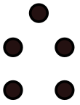 Torna al testo ↑
107 The cube, with eight vertices, and a unit represented at each vertex. Torna al testo ↑
108 The manuscripts actually read CC and CCC here, which Dick corrects to XX and XXX. It appears that Martianus, and not the scribe who copied the archetype, was responsible for the blunder. In a moment Martianus speaks of 2 and 3 as having the same ratio as 200 and 300; and later (§ 761), in using 300 and 200 as an example of the superdimidius ratio, he refers to this passage. If the scribe had been responsible for the error, he would have had to misread the figures in three places. Torna al testo ↑
109 Once again (cf. § 755) Martianus displays his limited comprehension of solid numbers by using examples in which one plane surface is superimposed upon another plane surface; as Remigius observes (ed. Lutz, II, 206), his solid figure “has nothing within and is merely surfaces.” Torna al testo ↑
[Note a pag. 293]
110 cf. § 752. Torna al testo ↑
111 There seems to be a lacuna in the Latin text here, and various editors have conjectured that the following should be added: “numbers exceeding other numbers by a part or parts epimereis [superpartients], and numbers smaller than other numbers by a part or parts hyperimereis [subsuperpartients].”
The Latin terms superparticularis and subsuperparticularis, in common use among historians of mathematics, got their currency from Boethius’ Latin translation of Nicomachus. See Institutiones arithmeticae 1. 24, 28. Robbins (Nicomachus, tr. D’Ooge, pp. 140-41) briefly discusses Martianus’ treatment of ratios and draws some comparisons with Nicomachus’ treatment. Torna al testo ↑
112 Cf. Theon, ed. Hiller, p. 74. Torna al testo ↑
[Note a pag. 294]
113 Cf. Nicomachus 1. 18; Theon, ed. Hiller, p. 16. Torna al testo ↑
[Note a pag. 295]
114 Cf. Nicomachus 1. 20-21; Theon, ed. Hiller, pp. 76-77. Torna al testo ↑
115 Dick agrees with Pctau that this sentence should be deleted because it is repeated immediately below. Torna al testo ↑
116 Cf. Nicomachus 1. 20. 2. Torna al testo ↑
[Note a pag. 296]
117 Cf. Nicomachus 1. 21. Torna al testo ↑
[Note a pag. 297]
118 Dick supposes a lacuna in the text here, with two words omitted. On his supposition, the full translation would be: “However, the terms are not increased for these numbers.” Torna al testo ↑
119 The reading of the extant text is corrupt. I have followed the emended reading of Paul Tannery, pp. 137-38: Pythmenes Pythagoricus Thymarides [sic] nominabat. Dick was unaware of Tannery’s emendation. On root ratios, cf. Nicomachus 1. 20. 1; 1. 21. 1; 2. 19. 3; and see Nicomachus, tr. D’Ooge, p. 141. Torna al testo ↑
120 Nicomachus (1. 19. 8) considers the multiple a more elementary and older form, and proceeds to indicate diagrammatically the development of ratios of members and parts. Torna al testo ↑
[Note a pag. 298]
121 Remigius ad loc. says that this refers to ratios combining multiplications and a ratio of members or of parts. Torna al testo ↑
122 Cf. Euclid Elements 9. 28. Torna al testo ↑
123 Cf. ibid., 29. Torna al testo ↑
124 Cf. ibid., 21. Torna al testo ↑
125 Cf. ibid., 22. Torna al testo ↑
[Note a pag. 299]
126 Cf. ibid., 23. Torna al testo ↑
127 Cf. ibid., 21. Torna al testo ↑
128 Cf. ibid., 22. Torna al testo ↑
129 Cf. ibid., 24-27. Torna al testo ↑
[Note a pag. 300]
130 Cf. ibid., 32. Torna al testo ↑
131 Cf. ibid., 33. Torna al testo ↑
132 Cf. ibid., 34. Torna al testo ↑
133 § 750. Torna al testo ↑
134 Cf. § 751, and § 773 (end). Torna al testo ↑
135 By “odds” he means “evens from odds.” See § 749. Torna al testo ↑
136 Cf. Euclid Elements 9.29. Torna al testo ↑
[Note a pag. 301]
137 Cf. ibid., 7. Def. 11; Nicomachus 1. 11. 2. Torna al testo ↑
138 On the dyad as the only even number that is prime, see Heath, History, I. 73. Torna al testo ↑
139 This statement is not true, as is seen in the example of 3 and 9, or 7 and 14. Martianus is not following a known source here. In § 781 he makes the correct statement about a prime and incomposite number that is taken with a number that is composite in relation to itself. Torna al testo ↑
[Note a pag. 302]
140 § 773. Torna al testo ↑
[Note a pag. 303]
141 Cf. Euclid Elements 7. 23. Torna al testo ↑
142 Cf. ibid. 25. Torna al testo ↑
143 Cf. ibid. 27. Torna al testo ↑
144 Cf. ibid., 27. Torna al testo ↑
145 Cf. ibid., 28. Torna al testo ↑
[Note a pag. 304]
146 Cf. ibid., 24. Torna al testo ↑
147 Cf. ibid., 29. Torna al testo ↑
148 Cf. ibid., 1. Torna al testo ↑
149 I.e., in continued proportion, as seen from Martianus’ example. Cf. Euclid 9. 15. Torna al testo ↑
150 To the reading of the text – si tres iuncti sunt – Petau added the words numeri minimi, assuming, according to Dick, that the words were missing from the Latin translation of the Euclidean proposition. Tannery, p. 128, reads minimi in place of iuncti. Torna al testo ↑
[Note a pag. 305]
151 Cf. Euclid Elements 9. 31. Torna al testo ↑
152 Cf. Euclid Elements 7. 26. Martianus adds the first pair and compares the sum with either number of the second pair. Euclid states that the products of the pairs will be prime to each other. Torna al testo ↑
153 Cf. Euclid Elements 7. 22. Torna al testo ↑
154 Cf. ibid., 21. Torna al testo ↑
155 Cf. Euclid Elements, 7. 32,31. Torna al testo ↑
[Note a pag. 306]
156 Cf. ibid., 2. Here Martianus gives an imprecise account of what is now known as the “Euclidean algorithm.” Torna al testo ↑
157 Cf. ibid., 3. Torna al testo ↑
[Note a pag. 307]
158 Cf. ibid., 34. Torna al testo ↑
[Note a pag. 308]
159 Cf. ibid., 36. Torna al testo ↑
160 Cf. ibid., 35. Torna al testo ↑
161 Cf. ibid., 36. Torna al testo ↑
[Note a pag. 309]
162 Cf. ibid., 20. Torna al testo ↑
163 Cf. ibid., 15. Torna al testo ↑
164 Cf. ibid., 30. Martianus says “either of the original numbers”; Euclid says “one of the original numbers.” Torna al testo ↑
165 Cf. Euclid Elements 8. 7. Torna al testo ↑
166 Cf. ibid., 6. Torna al testo ↑
[Note a pag. 310]
167 Cf. ibid., 9. 12. Torna al testo ↑
168 Cf. ibid., 11. Torna al testo ↑
169 Cf. ibid., 13. Torna al testo ↑
[Note a pag. 311]
170 Cf. ibid., 14. Torna al testo ↑
171 Cf. ibid., 8. 14. Torna al testo ↑
172 Cf. ibid. Torna al testo ↑
173 Cf. ibid., 16. Torna al testo ↑
174 Cf. ibid. Torna al testo ↑
[Note a pag. 312]
175 Cf. ibid., 15. Torna al testo ↑
176 Cf. ibid., 17. It should be noted that although Martianus states many theorems in the theory of numbers, and that he gives specific instances illustrating these, he fails to provide mathematical proofs such as are found in the Elements of Euclid. Torna al testo ↑
177 Cf. ibid. There is a lacuna in the text of Martianus here; the words “in the side of the other cubic number” have dropped out. Torna al testo ↑
178 Cf. ibid., 7. 37. Torna al testo ↑
179 Cf. ibid., 38. Torna al testo ↑
180 Remigius ad loc. (ed. Lutz, II, 236) explains: “If there is any flame left in our breast, which is the altar of wisdom, where we bring our offering of learning.” Torna al testo ↑
181 The abolla – which, according to Remigius, was the garment of philosophers. He says that they wore the garment doubled. Torna al testo ↑